Part 4 (of 6)
Artist writer filmmaker
Lis Rhodes, a dialogue with Nina Danino (2020)
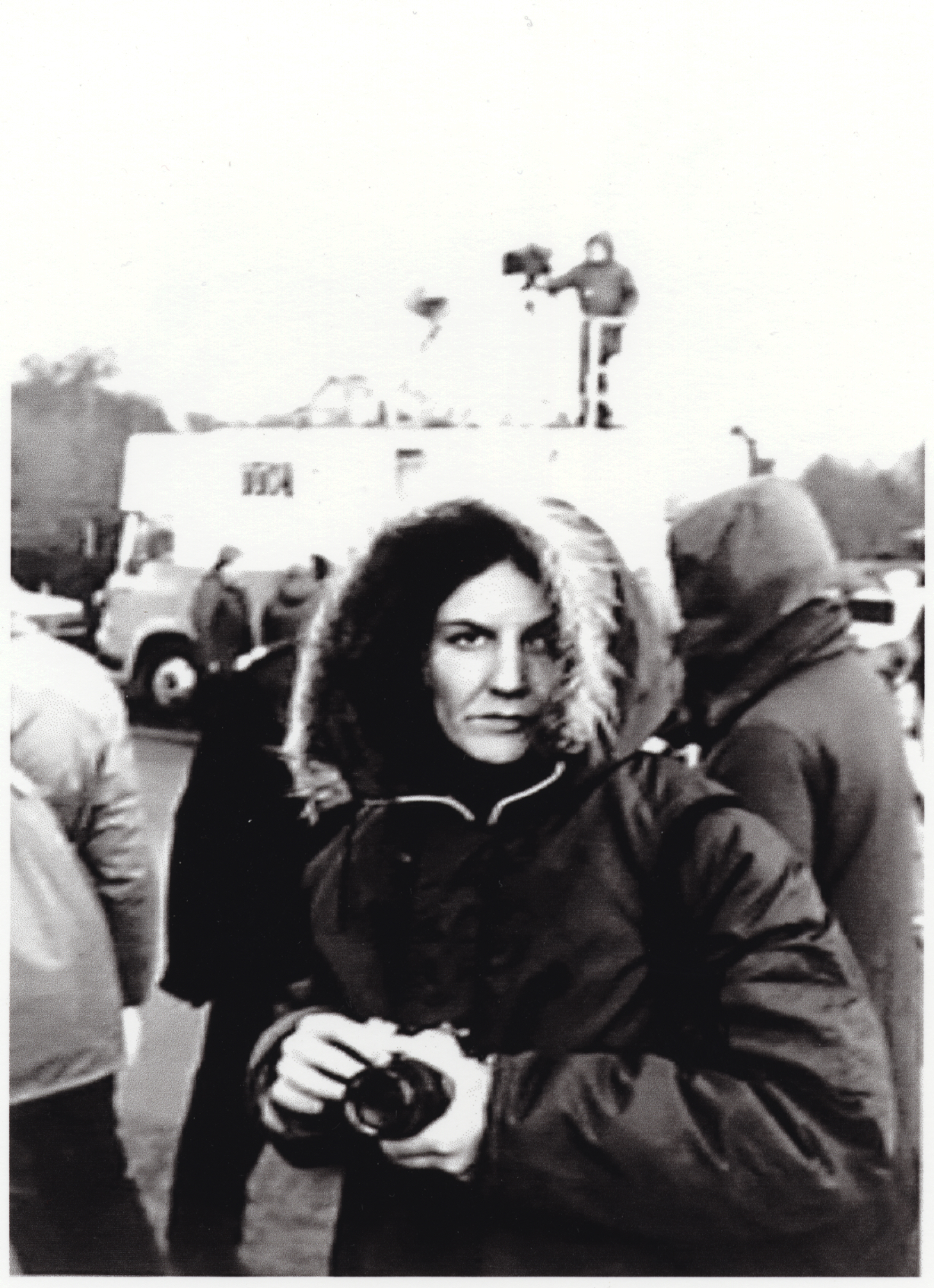
Still showing Lis Rhodes on Greenham Common (around 1982).
Copyright Lis Rhodes. Courtesy of the artist.
_______________
This
conversation is one of a series of six discussions undertaken by the filmmaker
Nina Danino in 2020. They were revisited and edited in 2024 for publication
online by LUX, London. The dialogue was created through an extensive email
exchange between Nina Danino and Lis Rhodes in 2020, which they then edited
carefully, lightly checked in 2023 and proofed for publication in 2025.
________________
In this written dialogue, Lis Rhodes offers her rhythmic poetry as
a way of answering Nina Danino’s questions, which were direct and intense. This
has to do with the written nature of their exchange. Originally, Nina Danino
sent questions that were intended to act a guide for a later spoken exchange,
but Lis Rhodes replied in writing, with meticulous thought and the utmost
focus. This focus is the very aspect of the work Light Reading (1978) that fascinated Nina Danino, as to her the
film seemed to inscribe a homing into something, a seeing of something through
the camera, a framing of it as part of a long process of writing, making and
thinking. As the voiceover in Light
Reading says, “images before thought, words prescribing images – images
prescribing sounds.”
Nina Danino was particularly fascinated about Lis Rhodes’ approach to her own self-image, seen in the blurred and occasional images of her black-and-white 16mm self in the film (which also at times show, though it is not readily apparent, a male figure). Even though, as this dialogue reveals, this self-image was not her intention, these aspects of the film have not been discussed much to date. To Nina Danino,
this process of inscription seemed integral to the iconic film Light Reading and her work as a woman
artist, but the framework for this inscription outlined by Lis Rhodes is very
different to that of Nina Danino’s – connected as it is, particularly in Lis
Rhodes’ later work, to the collective and subjective lenses through which
violence is experienced by women.
The responses in the exchange that follows attest to a critical attention that is also testimony to the theme of the ‘intense subject’ in experimental film – a core theme within Nina Danino’s artistic practice and this wider interview collection.[1]
________________
This conversation is one of a series of six discussions undertaken
by the filmmaker Nina Danino in 2020. They were revisited and edited in
2024/2025 when they were published online.
Please note that the opinions and information published here are
those of the speakers/authors and not of LUX or the wider research team and
institutions involved with their funding, transcription and publication.
Published online by LUX, London (2025)
Editing and research: Claire M. Holdsworth (2020/2025)
________________
Conversation
Written correspondence (emails), April – May 2020 (edited January 2025)
_____
Nina Danino:
The discussion will touch on
how aspects of some experimental film languages can represent – a ‘speaking
from the interior’ and a female/feminist/feminine point of view through key
concepts which are; self-inscription (process), materiality (practice), enunciation
(language).
There is already an archive
on your work, as an artist who writes as an artist/writer and the connection
between writing as practice to filmmaking. Your writing for your films,
catalogue, panel discussions, interviews were published in Telling Invents Told last year.[2] I also refer also to the interview you did with Jenny Lund for Feminisms: Women artists and the moving
image, which is very comprehensive.[3] So this conversation is not to add to this body of work or to interpretations
of the films but to locate concepts of self-inscription (process), materiality
(practice), enunciation (language) in the discourse of particular forms of
experimental film, through some moments or passages and or even frames, always
understanding that this is also an interpretive activity as a way of
approaching this.
Your body of work is diverse
and goes back to the seventies, but I would like to focus on the experimental
narrative films Light Reading (1978)
and Pictures on Pink Paper (1982)
which communicate a personal expressive intensity and are intended for linear
viewing. Perhaps that way that we can find inscription in the work, perhaps it
only exists in narrative forms as moments in given works. You suggested we also
discuss the films Journal of Disbelief
(2000–16) and Ambiguous Journeys (2019).
We will also touch on your experimental film context through the 1980s and
1990s to now.
Lis Rhodes:
In the
introduction you refer to a speaking from the interior – this is a concept that
I find difficult to understand. The binary forms that words are made to take
within the structures of language force absolute divisions in meaning. Implied
in speaking of an interior is the existence of an exterior. The implications of
the two concepts are more complex, in other words they suggest the subjective
and objective.
Surely speaking from the interior and a female/feminist/feminine point of view confirms misogyny in the bias of positioning women as ‘subjective’, driven by the ‘personal’ and ‘intuitive’ – and the misogynist holding the ‘objective’ to itself – defined as ‘(a person or their judgement) not influenced by personal feelings or opinions in considering and representing facts. “Historians try to be objective and impartial.”’[4] My essay, ‘Whose History?’ questions the absence of the subjective in the definition of objectivity.[5]
Equally the word feminine
gives many women pause for thought. There is a connection between the
expression of our understanding of what is seen – in the practice of
representation – and how much that understanding has already been learnt
through previous expression. The binary separation of definition of meaning is
misleading. In reality meaning moves.
Nina Danino:
My contention is that subjectively inscribed experimental film as a language, comes out of a drive, a need, for expressivity but also the rigour of structural, formal and theoretical concerns. An essay I wrote on ‘The Intense Subject’ attempted to locate this as a place of working which was/is unique or historically specific.[6]
Lis Rhodes:
I see your need for ‘expressivity’ but surely the problem is the
artificial fissure between expressivity and the ‘rigour of structural, formal
and theoretical concerns’, which is deeply embedded in a culture of opposites.
Unfortunately this is expressed through the ideology of competition – where
most are going to lose out.
a hyphen splits the world
competition an ethic
and gambling an economy[7]
This
reveals the inequity of a prevailing ethic – in how structures of language and
economics are reflected in each other and determine lived conditions.
Nina Danino:
Naturally I am approaching
artists whose films, as do mine, I feel foreground the subject/ive through the
trope of biography or autobiography and tropes of authorship through text or
voice over saying ‘I’ or ‘she’. I feel that yours perform this inscriptive
register too. Can we explore how the notion of authorship or consciousness is
performed and constructed in these films?
Lis Rhodes:
I don’t think the question
of authorship is particularly important in the work that I try to do. The
sources of the ideas are too diverse – to consider them mine. I make work
through various means - many are drawn to mind from different times – ideas may
find links – be reordered. ‘She’ in the collective sense is the carrier of
sense, the subject of the sentence. If there is an element of autobiography the
ageing of my voice is there. It is in the pitch of my voice between Light Reading and Ambiguous Journeys, a certain measure (from the note of D mezzo
soprano to the B of the alto). That makes sense of nonsense.
Nina Danino:
The soundtrack of Light Reading is spoken in the tone of a
literary reading, did this form influence your writing?
Lis Rhodes:
I’m not sure that I have
ever been to a literary reading. If Light
Reading is spoken in the tone of a literary reading it is simply that my
voice was the cheapest solution. The film had no budget, and I had no money.
1978.jpg)
Still from Lis Rhodes, Light
Reading (1978).
Copyright Lis Rhodes. Courtesy of the artist and LUX, London.
Nina Danino:
You worked in Compendium
Bookshop. Did this set a context – the scene if you like, for the inscription
of writing in your films and practice?
The London Film-makers’
Co-operative [LFMC] moved to Camden in the mid-1970s. Compendium was a hub for
writer/artists, readings/performances. Artist filmmakers performed there,
feminist writing and magazines such as Spare
Rib were sold there. There was the Only
Women Press in relation to the culture of writing – this was the context
that you connected to. It had connections to the art world – all the latest
theory books. I bought Peter Gidal’s Structural
Film Anthology (1976), Juliet Mitchell and Jacqueline Rose’s Feminine Sexuality: Jacques Lacan and the
École Freudian (1985) from there.[8] It was a centre for both ‘political radicalism and literary avant-gardist
writing’ in the 1970s, are these threads that you have wanted to keep running
through your work?
Was it poetry that influenced you at this stage? Gertrude Stein is referenced in the films and quoted as an influence on your own writing.[9]
Lis Rhodes:
I don’t think that working at Compendium was particularly
influential. Images out of the written had always been there from reading.
There is so much to say it brings relief to see sense in brevity. Maybe that is
the premise for poetry. Poetry moves between image and the notation of sound.
Working at Compendium was useful in that between the poetry – and then the
feminist section – I was working and reading the work I was doing. Something
that was rare before.
Nina Danino:
When did you begin to think of writing as part of your film practice?
Lis Rhodes:
Amanuensis (1973) was literally a
visually written film as the title indicates, ‘one who takes dictation or
copies manuscripts.’[10]
The images were printed from already used typewriter tape. The original text
was probably dictated to a secretary – almost certainly a woman. The spoken
translated into the visual. The meaning conveyed, unreadable. Later I used some
of the visual footage in Light Reading.
Nina Danino:
Was it to do with the voice in relation to writing?
Lis Rhodes:
Yes, but not my voice. The typist translated the sound of the voice, in the fragmentation of the words recorded in the silence of the visual on the typewriter tape – ‘she refused to think of the use to which that which was done would be put’.[11]
Nina Danino:
How did you decide to speak your writing? Did you draw on
performance of the poetry readings that might have been part of this milieu?
Lis Rhodes:
To read in reverse the silence of Amanuensis necessitated the decision to speak in Light Reading and that became integral to the film itself. The opening sequence is without image, just my voice reading aloud:
she will not be placed in
darkness
she will be present in
darkness
only to be apparent
to appear without image
to be heard unseen.
This is reiterated at the
end of the film:
she refused to be framed
she raised her hand
stopped the action
she began to read
she began to re-read aloud
Nina Danino:
In Dresden Dynamo
(1971-72) and Light Music (1975–77)
sound is the image and vice versa. What made you move away from this modernist
interest in concrete sound and decide to read the writing aloud in Light Reading which is read by one voice
alone?
Lis Rhodes:
I haven’t moved away from my interest in sound or its relation to
image. Dresden Dynamo was made to
counter the illusion that the soundtrack to a film has necessarily any
relationship with the visual. At the time I had no movie camera or audio
recording equipment. I made the film by hand with the intention that the sound
would be the image - the image the sound - one symbolic order read as another.
In a sense Amanuensis was similar in
that I thought the images on the optical track might have sounded. Actually,
the near silence became the silence of the written - printed from the used
typewriter tape - extracts of which were used in Light Reading. Between Amanuensis
and Light Reading, Light Music was made to counter the
apparent absence of women composers. Later, I composed soundtracks from
synthesiser notes, piano wires 5 metres long, with and without voice.

Image of drawing on paper. The drawing was then filmed on a
rostrum and became the score (printed onto the optical track) for Lis Rhodes, Light Music (1975).
Copyright Lis Rhodes. Courtesy of the artist.
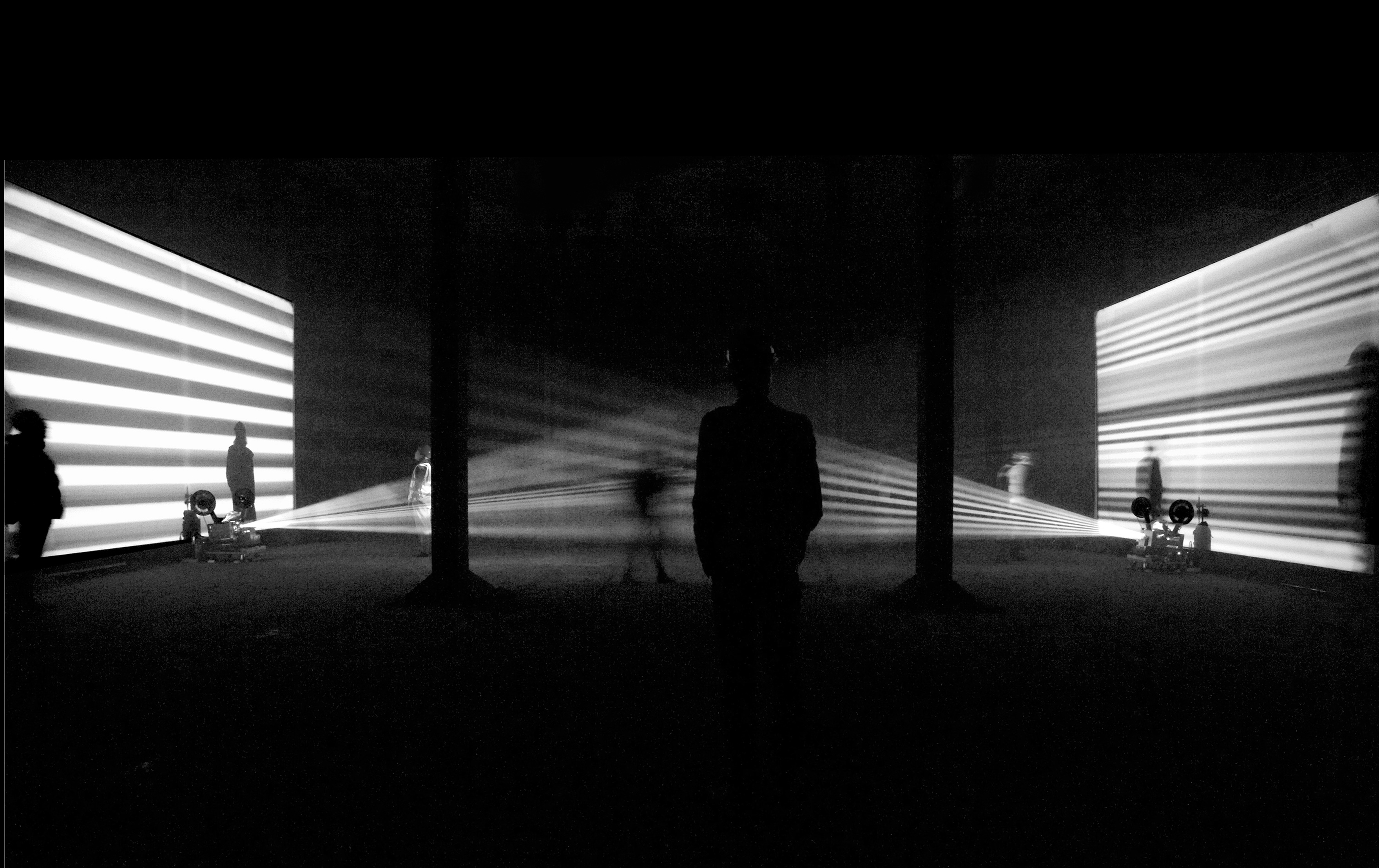
Installation shot (Tate Modern) of Lis Rhodes, Light Music (1975).
Copyright Lis Rhodes. Courtesy of the artist and LUX, London.
Nina Danino:
The voice brings with it the subject’s whole body and presence.
How do you feel that the voice related to the body? It isn’t just vocalisations from the
experimental music scene of the 1970s, like Cathy Berberian and Meredith Monk
or Dagmar Kraus, who performs vocals in Pictures on Pink Paper. In Light Reading
the voice is saying, trying, to communicate something in and through language.
Where did you get the idea of speaking in the film?
Lis Rhodes:
The opening sequence of Light
Reading has no image. It is the voice that is present. If there was a
certain reason for using my voice, it was to question the use of English
language, its grammatical structure and binary divisions. That these questions
had been and have been raised by many women - makes explicit the shared nature
of thought. This struggle with the problems of language defining experience
runs through much of my work, realities are denied, expression suppressed.
'A word is dead
When it is said,
Some say.
I say it just
Begins to live
That day'.[12]
Did you weigh every word?
Each one
One by one?
Weighed - weighed one
against another
But if there's no comparison...
No memory
There will be...
No dissent [13]
The idea of speaking in film
was implicitly there in the silence of Amanuensis.
Nina Danino:
How does Light Reading enunciate an authorial
consciousness which could be called inscription?
Lis Rhodes:
The consciousness in Light Reading is hers, she is the carrier of sense:
in her own voice she cried
the end cannot be confused
with the end that ended
somewhere
but not here not here at the beginning.
Nina Danino:
Certain experimental forms in film might be read through a notion of authorial consciousness. Anneke Smelik in And the Mirror Cracked[14] talks about the ‘female subject’[15] as a multi-layered, embodied inclusivity, feminist consciousness is a process that structures relations between direction, film text and spectator, a film form which encompasses strategies and rhetoric. I found her use of literary theory transposed to film convincing because it points to an understanding of the totality of film as a discourse.[16]
Lis Rhodes:
To begin I haven’t read Anneke Smelik’s book And the Mirror Cracked. I’ve never worked within the parameters of
direction, film text and spectator. I think that there may be an underlying
problem in constructing a definition of the ‘female subject’. This is
compounded in ‘feminist consciousness’ – of which there are so many we shall
never know. I think perhaps we should be wary of defining even [as you said]
‘multi-layered, embodied inclusivity, feminist consciousness’ since lived lives
– in their particular context – are infinitely varied. I suppose that the
immediate question is, who is excluded from this multi-layered embodied
inclusivity? I think that I am addressing the problems that women face, not
attempting to define a female subject. Wouldn’t that be the imposition of yet
another limitation not a liberation? Definitions raise problems in their
fictional finality. Everything moves, except misogyny itself – why, oh, why?
Nina Danino:
In Pictures on Pink Paper we hear several women’s voices talking aloud
but there is one voice that asks the questions – a sort of consciousness over
the other two (three?) which lack the same reflective interiority. Is it when
these elements cohere that we reach the discourse of the authored consciousness
of the female subject?
Lis Rhodes:
I did many recordings for Pictures
on Pink Paper (1982). There were five voices in the final version including
Dagmar Krause and myself. The suggestion is that when these elements cohere,
there is a consciousness of the female subject. This implies a certain stasis
in discourse and objectification of their voices. The last words sung by Dagmar
Krause are –
does nature produce
the nature in us
or is it their nature
that’s natural – not us
is it natural in nature
to subjugate us
or is it naturally
nature to them – I mean men
to think of a nature
especially for us
a feminine nature
designed by them
but naturally – quite
unnatural to us[17]
These are really the questions that came to be the work that’s
heard and seen. I again stress there can be no singular ‘female subject’. There
are infinite female subjects. Each voice remains particular. Between the
particular there are certain shared concerns.
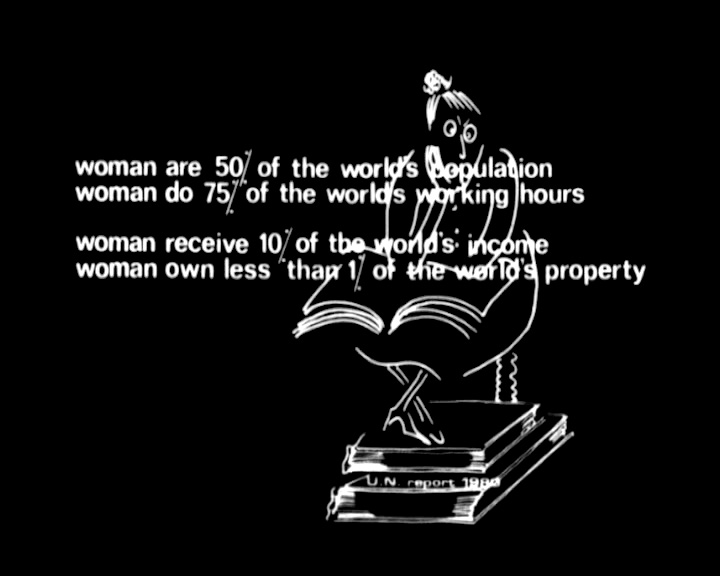
Still showing drawing by Lis Rhodes alongside statistics from ‘UN
Report c.1980’ in Lis Rhodes, Pictures on Pink
Paper (1982).
Copyright Lis Rhodes. Courtesy of the artist and LUX, London.
Nina Danino:
Yet this consciousness
suggests introspection it is in flux and in Light
Reading it is a constant state of self-questioning or self-interrogative
speaking in a rhetoric of anxiety and indecision, ‘shall I?’ spoken in the
cadence of poetry, such as rhythmic address.
Lis Rhodes:
Light Reading is, in the sense of a
constant state of questioning, a continuum of critique of the structures of
language, which attempt to define so much of the world as it was and still is.
And still women are having to argue and explain the obvious.
was she working back to
front
front to back
images before thought
words prescribing images –
images prescribing sounds
which was in front of why
was it just the orientation
of her look
the position of her
perception
the back of the front
or the front of the
back
she listened
she looked at the soundings
of the image
[18]
[…]
Nina Danino:
I think struggle is an
important part of the consciousness of the subject as a register in/of these
films. Your films often deal with the discourse of social strife which to me
can also be understood as conveying a subjective experience. This struggle then
extends to the form of experimental film practice itself – a form which is not
easy, it doesn’t come easily, and it shouldn’t. It is a struggle to make a new
form for oneself between and the process of making film in the search for
(self-representation). Does this strike a chord with you?
Lis Rhodes:
I’m hearing several chords in your question. Understanding is
complicated, so much is hidden suppressed – refuted and erased. Dangerous for
some, reflected in the number of writers who are or have been in imprisoned. I
see the ‘struggle’ not so much between making a new form for oneself and the
search for self-representation, but rather taking apart the abstract structures
– law, education and economics – that determine how division enforces
oppression. This in itself necessitates an undoing of established forms of
language. Telling this as it is – be careful, truth is a commodity, and it
tends to cost.
Nina Danino:
How do you build in
discourse of a female subject in your films? Is it the use of pronouns?
Lis Rhodes:
she laid the words with care
among the dripping plates
the issues are defined
what is spoken – that is
seen
in black or white – as left
or right
either ... or
two sides to every question
[19]
A pronoun cannot hold the diversity and complexity of gender. It
may work as an indicator in certain contexts. There are many ways to move, in
questioning the two sides of the answers given – the underlying patterns of
control need constantly undoing. I question – the binary opposite of this to
that. Their movement together is the moment of concern and hope. It is
obviously necessary – so many women from all over the world are doing just
this.
Nina Danino:
You write ‘saying what you mean within the confines of syntax is
like squeezing sense from the imaginary.’ In this space of what is squeezed out
is the subject – in abstract structural film, the woman is squeezed out, only
to appear as enigma – the mastery of the apparatus in structural film is itself
the means to an end. How did you cope with this ‘becoming enigma’, did it lead
to the necessity to project yourself through enigmatic concealment in order to
carry out your work?
Lis Rhodes:
As I understand ‘abstract structural film’ it is associated with
the ideas of the structural linguistics of Swiss linguist Ferdinand de
Saussure, the anthropology of Claude Lévi-Strauss, and later by writers such as
Roland Barthes, Louis Althusser, and Jacques Lacan. If this is the case – that
she is squeezed out of the concept of abstract film it is similar to her
exclusion from musical composition, theoretical mathematics, philosophy and the
underlying structures of language. This is precisely where she was, and needs
to be, but her contribution has been erased. These are the systems that define
the conditions that determine living – and surely it is here that change is
long overdue. Is this ‘enigmatic’? This concealment and erasure of the work
done by many women is still suffered today. Just as domestic work and the low
pay of care workers indicates the disregard of the importance of the work they
do.
Nina Danino:
You show the close up of a face in a compact mirror in Light Reading – it is an image which is
in soft focus. Was this reflection in the mirror a part of the necessary
condition of being and presenting yourself as a woman and the woman artist?
That is, the artist’s confrontation with image and self-image?
Lis Rhodes:
The mirror image is where she was meant to be – and so I had a
look at it myself. The questions that run through Light Reading are looking at the abstract means of oppression that
underly the more overt problems that women are still facing within the varying
extremes of patriarchy.
she watched herself being
looked at
she looked at herself being
watched
but she could not perceive
herself
as the subject of the
sentence
as it was written
as it was read
the context defined her as
the object of the explanation
[20]
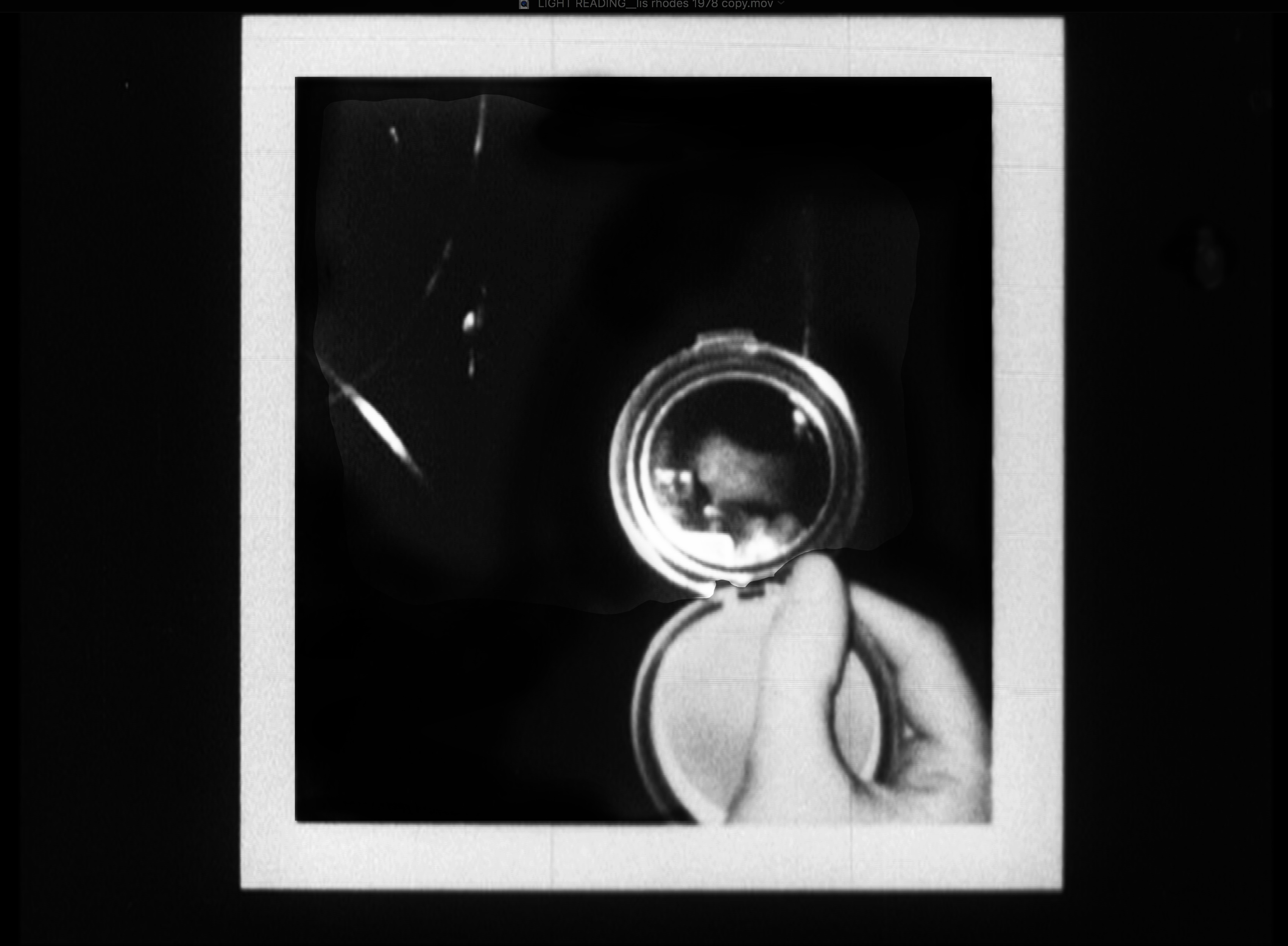
Still from Lis Rhodes, Light
Reading (1978).
Copyright Lis Rhodes. Courtesy of the artist and LUX, London.
Nina Danino:
Hair can be the synecdoche and fetish of self-presentation for
woman. Barbara Meter’s film Traces
(1990), which is removed from
circulation, stayed in my memory through the slowed
down sequences where she is walking and is crowned by wild hair. Your red hair
as a young woman makes me think of a Pre-Raphaelite maiden. Not Ophelia who is
horizontal and thus passive, this figure is standing. Is this photograph the
signifier for the filmmaker and the self?
Lis Rhodes:
The analogies you are suggesting are male concepts. You are quite
right that hair is culturally determined and can be used as a method of torture
and repression. Just this morning I have been looking at a photograph of the
mayor of Vinto in Bolivia in a newspaper article which describes how, on 7
November 2019:
an opposition mob stormed
the municipal headquarters and dragged the mayor Patricia Arce, into the street
before setting the building ablaze.
Morales said in a tweet on
Thursday that Arce – a member of his ruling Movement for Socialism (MAS) party
– had been “cruelly abducted for expressing and defending her ideals and the
principles of the poorest.”
Television images showed her
on the ground, her hair cut, and covered in red paint. She was dragged and
forced to walk barefoot through the town by the mob before being rescued by
police on motorcycles.
Morales’ party demanded the
police bring the perpetrators to justice.
Arce’s office told local
media on Thursday the mayor “is recovering” from her ordeal.
[21]
In the words of my film Riff
(2004):
women accused of
collaborating
had their heads shaved
the deportees who returned
were mistaken for
collaborators
their heads too had been
shaved
being identified is both
ritual and illusion
[22]
Women’s hair is uncovered as a sign of ‘freedom’ and covered as
‘control’ – both unnecessary symbols.
Nina Danino:
In the process of self-portrayal in Light Reading does the subject and object come into conflict in
that compact mirror? Did you see this film as a catalyst or a drama of/for
‘selving’?
Lis Rhodes:
No, I don’t see the images in the compact mirror in Light Reading as ‘selving’. In the film the compact mirror reflects both genders in a frame usually intended to reflect the female only. Light Reading is a reading of violence towards women – whether physically or in the abstraction of language. Felicity Sparrow wrote that the ‘film begins in darkness as a woman’s voice is heard over a black screen. “She” is spoken of as multiple subject – third person singular and plural.’ [23]
Light Reading ends with no single solution. But there is a beginning. Of that
she is positive. She will not be looked at but listened to:
“she begins to re-read – aloud”
[24]
Nina Danino:
Thinking about visibility and woman as author, do you want to be a
veiled figure both in your work and as a persona? Was film authorship part of
an impulse to evade exposure or to come into the field of vision? Is the
avoidance of clear figuration part of the impulse to resist
self-representation?
Lis Rhodes:
I am not resisting self-representation. Light Reading is a critique of how women are imaged – without
voice:
she watched herself being
looked at
[25]
[…]
she refused to be framed
[26]
The
structures of language and the violence implied both mentally and physically
towards women are at issue here.
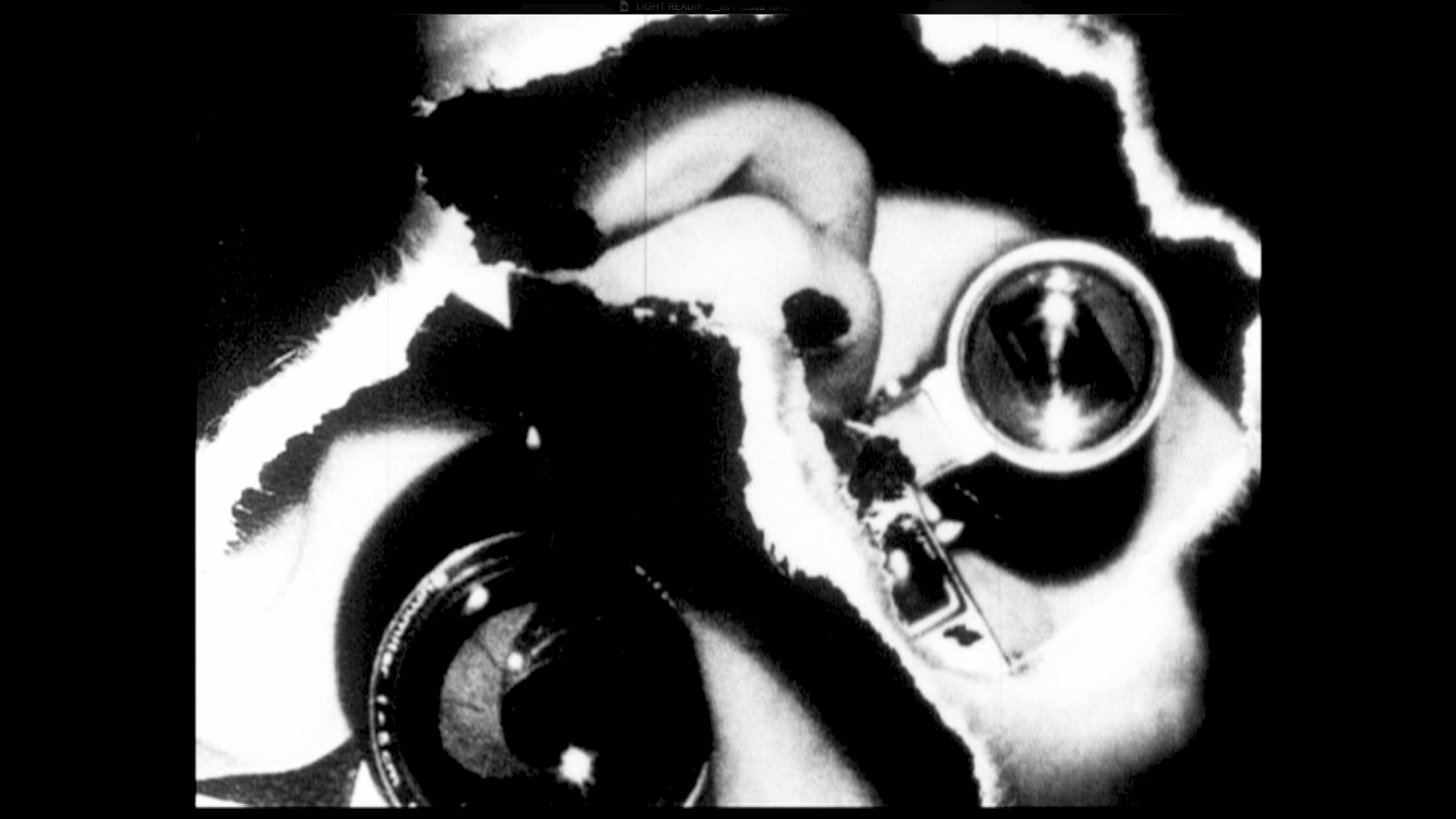
Still from Lis Rhodes, Light
Reading (1978).
Copyright Lis Rhodes. Courtesy of the artist and LUX, London.
Nina Danino:
Anneke Smelik says that the speaking subject in discourse is
present, whilst in story they are masked. The subject of enunciation is the
cinematic apparatus as a whole – camera movement, montage, point-of-view,
composition, soundtrack and so forth. The discourse of subjectivity is both
questioned and presented, enunciated in these experimental films through the
camera or sound and editing and the development of experimental film language
to create new forms of representations as authors. We are looking at visual
language in film as part of authorial consciousness – could we look at your
visual language?
Lis Rhodes:
Anneke Smelik makes an interesting comment, but at what point does
a discourse become a story – a story a discourse? The news reader uses the
phrase ‘news story’. The speaking voice is reading the editor’s script – both
are masked – in the representation of the facts. Or are these facts stories?
Equally but differently, the voice in discourse may tell a story whether true
or not – the mask is shared. Do we rely on the filmic equipment to tell us a
truth of authorial representation? If I have a visual language, it is in the
writing I write and the sounds I compose – the images I paint and the paintings
I image.
Nina Danino:
You made expanded works between 1971 and 1976 in an
interdisciplinary context of the avant-garde practices of performance,
experiments in music, structural film, mainly in London and New York. You
resist being read within one form of production instead incorporating a range
of interdisciplinary practices which span across installations, sound and
linear film and you have said that you do not wish your work to be sectioned
off into different compartments.
Lis Rhodes:
I think that most of the expanded film works that I was involved
with were made between 1973 to 1976. The initial thinking was to undo the
established cinematic structure of film to audience. At the ICA [Institute of
Contemporary Arts, London], Ian Kerr and I did a nine-hour performance, Bwlhaictke (1976) with two 100-foot
loops of film where the soundtrack was made while the audience came and went.
The sound gradually increased in intensity from near silence at the beginning
and again at the end. At the Acme Gallery [London] we performed the action of
editing and re-editing in a series of variations on a short piece of music
composed by Cornelius Cardew for the performance CUT A X (1976). It was a live performance creating a series of
variations in sound. In a sense there was no film – there is no film. It all
happened once.
Nina Danino:
You studied at North East London Polytechnic, was that in
Painting? What led you to take up filmmaking as a practice?
Lis Rhodes:
No – it was Communication Design. It was very simple – I wanted to
understand sound in relation to image. In word and image – voice and depiction,
sentence and scene – there is construction of an apparent veracity – a
transparent relationship between what is seen and what is said, which I didn’t
always see and didn’t necessarily believe.
Nina Danino:
In identifying the means of
production as a way of also trying to locate the operation of inscription is
perhaps obvious, but I feel it is the one place where we must look because it
is different from artists’ moving image where content is a given. Perhaps we
need to do this by going into Light
Reading. Would you draw out the relationship between the means of
production and the purpose for which you were using it?
Lis Rhodes:
With great difficulty – I don’t seem to work quite as your
question suggests. I usually find myself working between the sound and drawing
– image and writing. Some images in Light
Reading, as I have already mentioned, emerged from Amanuensis (1973) and then from another short piece of work made in
1975. So the images, conception and writing came together gradually, rather
than in a consideration of ‘production’ and ‘purpose’. This is why experimental
can be a useful word sometimes. The search is to disturb accepted meanings that
permit oppression and exploitation – necessitating re-thinking systems of
production. Hence the significance in Dresden
Dynamo of negating any illusion between what is seen and what is heard. A
noisy moment in the search for precision in the relationship between the heard
and the seen.
Nina Danino:
Would you talk about the rostrum camera in relation to the visual
language of Light Reading? In Light Reading we see the materials:
rulers, photographs, torn newspaper article, being arranged and re-arranged.
Previously you had made films without film, was this the first time you were
using this piece of equipment?
Lis Rhodes:
I used a rostrum camera in the making of Light Music. The composition of certain sounds is determined by the
distance between the lines of the original drawings. Read by the optical head
on a 16mm projector the distance between the lines changes the pitch of the
sound. The speed of the zoom changes pitch and tempo of the sounds. So, in Light Reading there was already
experience in using the camera. The problem was getting access – that certainly
took time.
Nina Danino:
I’d like to ask about your
process of work. Did you make Light
Reading at the Royal College of Art [RCA]? I recall using the rostrum at
the RCA which I used to make my first film which is not in circulation It was a
large dark room professionally set up.
The rostrum was commercially
developed for animation; much experimental film can be thought of as animation.
You could exert close levels of control, whereas working as a director with a
crew was perhaps a role less inaccessible to women. Did the access to the means
of production as a woman at the time have a bearing?
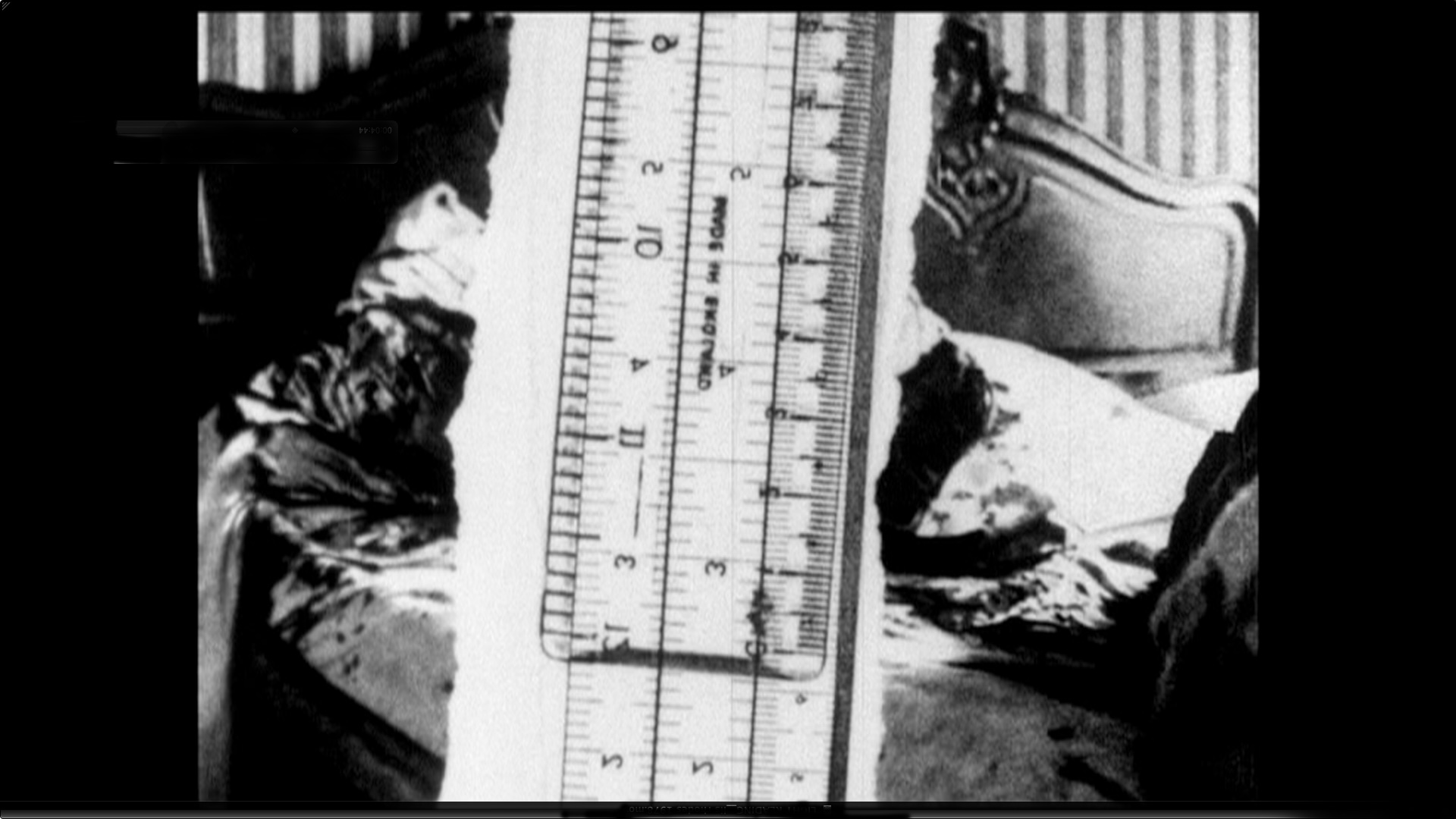
Still from Lis Rhodes, Light
Reading (1978).
Copyright Lis Rhodes. Courtesy of the artist and LUX, London.
Lis Rhodes:
I don’t get the impression that working as a director with a crew was remotely possible in the 1970s. Certainly for a woman filmmaker with no budget, I was very aware of the constraints on women filmmakers when I joined the union, the ACTT [Association of Cinematograph, Television and Allied Technicians] in the late 1970s as a sound recordist.[27] There were practically no women camera operators or sound recordists. I also wonder if such a hierarchical mode of work would have undone the premise and way I was working on film.
Nina Danino:
Was it just available – because improvisation also plays a role –
not everything has to be controlled to the frame does it? Did you work it out
as you made the film, or did you have a plan? How did the rostrum open the
possibility of exploring film in different way to you as a woman filmmaker?
Lis Rhodes:
No – Light Reading wasn’t made at the Royal College of Art. I can’t
actually remember where I made it. It might have been Croydon Art College where
I was teaching.
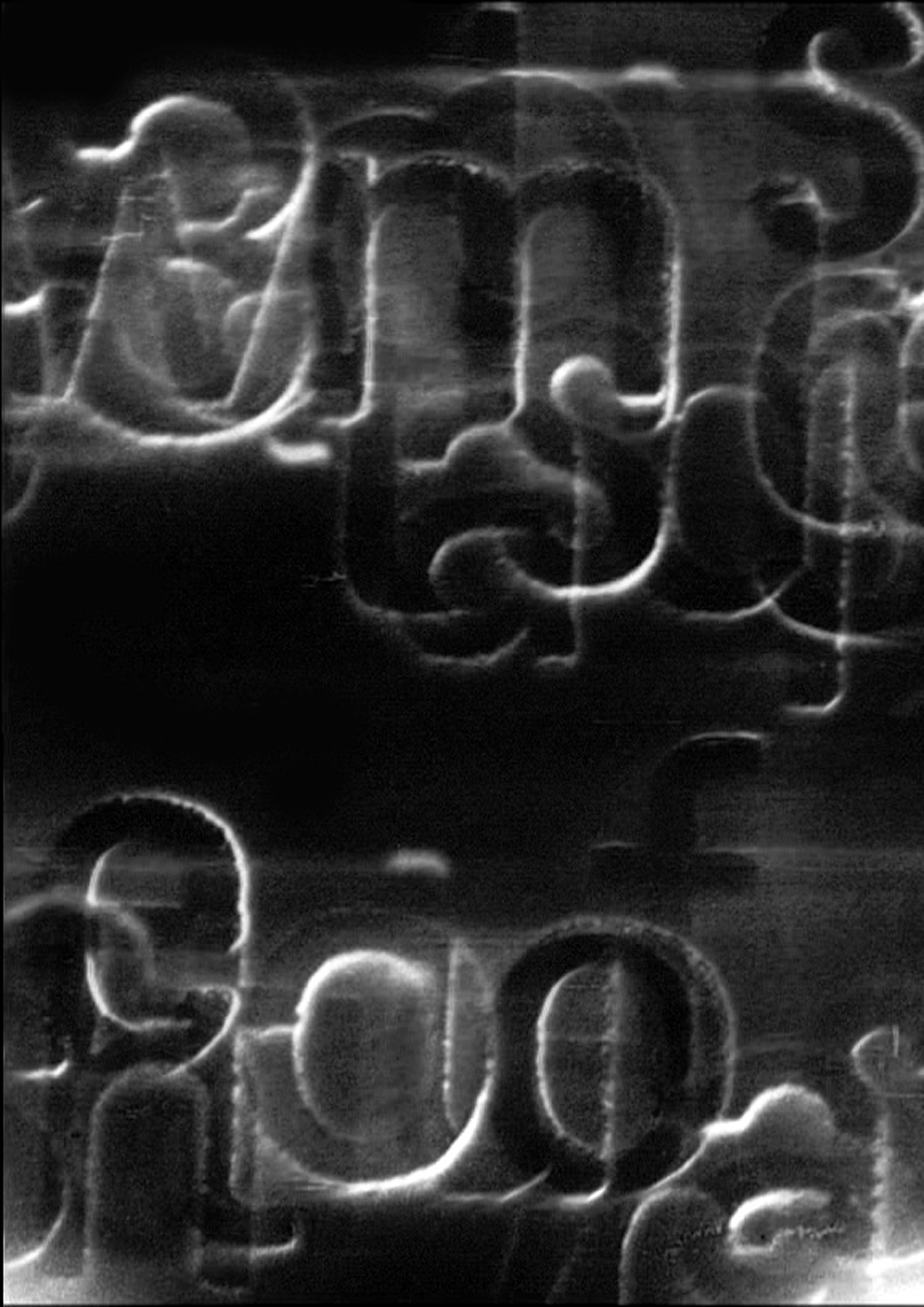
Still from Lis Rhodes, Light Reading (1978).
Copyright Lis Rhodes.
Courtesy of the artist and LUX, London.
Lis Rhodes:
Light Reading was made over a number of
years – much of the visual material I had printed by 1973, the writing written
from time to time, the images gathered similarly. There was no budget. The work
I do is focussed on the abstract systems that control and measure, so I have
tended to avoid representing the symptomatic as natural. In that sense, a
rostrum camera was both logical and useful.
Nina Danino:
Inscriptive practice could be an attempt to give meaning through
process with reference to structural/materialist film practice which provides a
rigour through a notion of pushing the machine to its ideological limit, albeit
that materialist film wanted to do the opposite, to empty meaning.
Lis Rhodes:
It’s difficult to empty
anything of meaning. Nothing means so much. A line of words across the borders
of a sentence – the image is drawn away. To capture meaning without control –
is difficult to do. Whether that is the grammar of the English language – or
the legal implications of law – there is no separation in the means and power
to capture.
Nina Danino:
As a woman, did the mechanical means of production become a machine for looking for something and meaning giving? Literally looking through the lens and the act of looking is intense. What were you looking for in your process could you look through the lens of the rostrum camera?
Lis Rhodes:
Well, if I remember correctly, I did look through the lens. This
can need a short ladder. But I used several different rostrum cameras –
sometimes at night when not in use by technical staff. With Light Reading the action was more
performative – often literally movements by hand.
Nina Danino:
Can you comment on what kind of looking you were doing – what was
it enabling you to see?
Lis Rhodes:
[…] some things are very
disturbing
and so they are
that is how they are
intended to be
[28]
The succinct attributes of
lines drawn and drawn in words can be very fast in undoing the order of things
– as they are assumed and imposed to be – which is useful when finance is short
and time curtailed.
Nina Danino:
Did your engagement with this mechanism lead to seeing something
you hadn’t seen before or to discover or to do something that couldn’t be done
in the forms you’d been using? Of course, it must give you the power of
control?
Lis Rhodes:
No, not seen before – but yes, it definitely led to something I
hadn’t heard before. This was the relationship between a particular distance,
between lines drawn on a piece of paper that would create a sound that was the
approximate equivalent of a middle C [musical note].
Nina Danino:
How have you transferred this memory in your practice, from
mechanical to digital films today? In your most recent film, Ambiguous Journeys (2018) there is a
repeated series of digital horizontal and vertical pans which frame the text a
bit like Peter Greenaway’s film Vertical
Features Remake (1978). I wrote down in my notes ‘The metaphors of words
and Journeys. Rostrum pull ins and pans combined with stretches’.
Lis Rhodes:
There is no rostrum work in Ambiguous
Journeys. The movement in the images is digital. Usually, I work with the
sound and image together – not one and then the other. But with Ambiguous Journeys I composed the
soundtrack first, recording my voice and using single notes played on a
synthesiser, collected over time, to construct the sound to the voice. It was
in the composing of these digital notes that I stretched notes individually –
changing the pitch and duration – that led to a similar response with some
images: the sound shifting the image, the image defining the written. The text
is open to be read, heard, or both.
Nina Danino:
Can you talk about the act of framing and reframing, as a
repertoire in your visual practice?
Lis Rhodes:
In Journal of Disbelief
(2000–2016), which deals with various aspects of law, there is an image of a
sign – framed and reframed behind barbed wire – of the notice naming the prison
Camp Delta JFT Guantanamo in Cuba. This carries the inscription ‘HONOR BOUND TO
DEFEND FREEDOM’. Written on the images in Journal
of Disbelief is the text:
[image]
with a shift of perspective
[image]
similar actions are
differently judged
when viewed
from a different point of
view
[29]
How this critique will be read depends on who is reading and why.
The framing and reframing call judgement into question.
Nina Danino:
You are against metaphor, so framing is a form of emphasis and
visual control through which you direct the viewer’s eyesight and ideological
attention isn’t’ it?
Lis Rhodes:
Yes. The evidence is there in representation. The frames are
framed to initiate a questioning of the meanings implied.
Nina Danino:
Can you comment on framing
from the perspective of gender?
Lis Rhodes:
In Light Reading the
text takes a direct swipe at gender inequality – through the ideological
structures in language, to the question of who defines the frame in which she
is to appear within.
[…] her thoughts framed
her image outside the frame
re-framed – by whom
in whose frame
[30]
[…] she was seen as object
she saw as subject
but what she saw as subject
was modified
by how she was seen as
object
she objected
[31]
Nina Danino:
My third question is about the soundtrack. Did you train as a
sound recordist in the 1970s? Many experimental filmmakers moved across sectors
– documentaries for television too. We weren’t isolated.
Lis Rhodes:
I didn’t train as a sound
recordist or work for the BBC – I simply joined ACTT. My work has been shown on
Channel 4 and the BBC and the Hang on a
Minute series was funded through the workshop agreement with Channel 4.
Nina Danino:
Returning to the voice – what were you trying-out in Pictures on Pink Paper? You add several
women’s voices and sound effects. When
I made First Memory (1980) I had not seen Light Reading. I made my recordings
in the sound studio at Environmental Media at the Royal College of Art in total
isolation and my use of the voice came from my interest in writing and
narrative literature.
Lis Rhodes:
Perhaps Pictures on Pink
Paper is a philosophical narrative – without beginning or end. A play
between the women’s voices – who speak the words I wrote:
to try to make real
what is unreal
is to mistake the nature of
things
but if the nature of things
is a deliberate mistake
and really not so real
then it’s quite essential
to make real what is ideal
it’s all a question of
who makes real – whose
ideals
whose values are valued <
as the nature of things
i think ... she said
[32]
The catastrophic acceptance of established meanings permits the
use of phrases that are slanted to justify power – as a natural state of being.
Nina Danino:
Many structural films are
silent or mute, thus revealing its own condition of material and thus also
being anti-illusionistic. The sound to Dresden
Dynamo (1971/2), a structural film with a scattergun/staccato noise, is
produced through the application of Letraset alphabet letters on the physical
film itself. In Light Reading in 1978
you decided to use speech in voice over, what made you do this? Did the
feminist context enable this move?
Lis Rhodes:
In Dresden Dynamo the sound is the image.
The sound is not intermittent. It is exactly as the optical head reads the
image. The image laps onto the optical track. This determines the level of the
sounds – there is no actual silence. What is heard – is seen. There is no space
for manipulation as there usually is in the editing of sound to image.
As I said earlier, Amanuensis was made to hear how the used
typewriter tape would sound – would the fractured words be readable. In Light Reading if words were to appear in
the film it would be in terms of voice not image. Women’s resistance had a long
history before Light Reading was made
– philosopher Mary Wollstonecraft wrote in A
Vindication of the Rights of Woman in
1792. I’m sure that the voices I was hearing and the books that I was
reading at the time were influential.
Nina Danino:
Ambiguous Journeysand Journal of Disbelief have an electronic sound composition adding a
strongly evocative layer. Can you comment on your decision to use music? We are
free to create accessible and viewer orientated reception for films at a
different time and for a different audience – did you want to assert this too?
Lis Rhodes:
In Ambiguous Journeys I
was editing the voice track at the same time as making various short phrases of
sound, which perhaps indicates how closely the sounds affect the words. The
words are phrased to the sound seen within the image. I don’t know how a future
audience will hear this composition or read the film. At the Nottingham
Contemporary exhibition in 2019 the film was screened in the context of The
List of 36,570 documented deaths of refugees and migrants due to the
restrictive policies of ‘Fortress Europe’. The context will change.
The Journal of Disbelief is different in that it was to be a film and book at the same
time. To be seen in sound and silence – to be read in silence. So far it is
only the film that is complete. The composition of the soundtrack is far from
the image. Some of the sounds as they are come from elsewhere. I recorded them.
There were the voices I could hear and those I couldn’t hear. The sound is
episodic – as is the journal as a format.
Nina Danino:
Recently your work has received solo shows and is being
recognised. What do you take forward from that experience with regard to facing
a new public for the work?
Lis Rhodes:
I think that there is a wide recognition that inequity is now so
great – the damage being done to the planet is untenable – international law is
being broken – violence is endemic underwritten by the arms manufacturers and
traders – and governments represent finance not the people. Young people are
very aware that this must change. I’m with them.
Nina Danino:
The 16mm expanded works between 1971 and 1976 that we have just
described between Dresden Dynamo and Light Music fit in well into the museum
and gallery installation today. The formal and physical aspects of the
installations work for a museum audiences but conversely I wonder if the linear
works are too intense for a gallery viewership? I’m talking about my own films
too here and the other films that have this in common. It’s this that I am
interested in – that aspect of ‘being too intense’ what is that exactly?
Do you call your practice
today say Journal of Disbelief,
artists’ moving image, or experimental film or do you see experimental film as
a historically specific practice? Does it matter? Is it relevant?
Lis Rhodes:
I follow what you are saying. The context of screening matters.
Many films – yours included – need the quiet seating of a cinema – a reading of
film that opens and closes in a linear sequence. In the expanded work that I
was involved in the ICA Festival of
Expanded Cinema in 1976,the Tate in 2009 and 2012 the gallery provided a
space where the transitory presence of the audience – in some degree – undoes
the hierarchical structure of the cinema. I think that the concentration of the
audience can be as intense in either case – gallery or cinema – but differs
depending on the consecutive time needed to read and consider the work being
screened. The gallery space makes this more problematic as the audience is
mobile. This was brought into focus in the setting up of the exhibition Dissident Lines last year – where the
crossing of the various film soundtracks was very carefully arranged
acoustically. It allowed the various prints on the gallery walls – including
the LIST – to be read in the trace of
the film sounds.
In answer to the second part
of your question – I would say no, I am not an artist of the ‘moving image’. I
am not sure that images move – light moves and digits change; but image has no
movement. That surely is an illusion. I’m certain that work depends on context
and the sharing of ideas but not – by definition – under a certain heading.
This is – not of course – always my decision to make.
Nina Danino:
The means and materiality. I
would like to explore the concept of materiality which, in the context of your
current work is digital. The experimental filmmakers that I have talked to,
associate materiality with a direct relationship to a physical hands-on
engagement, with formal mechanisms and 16mm celluloid, but like many artists
now, you produce your work entirely on digital.
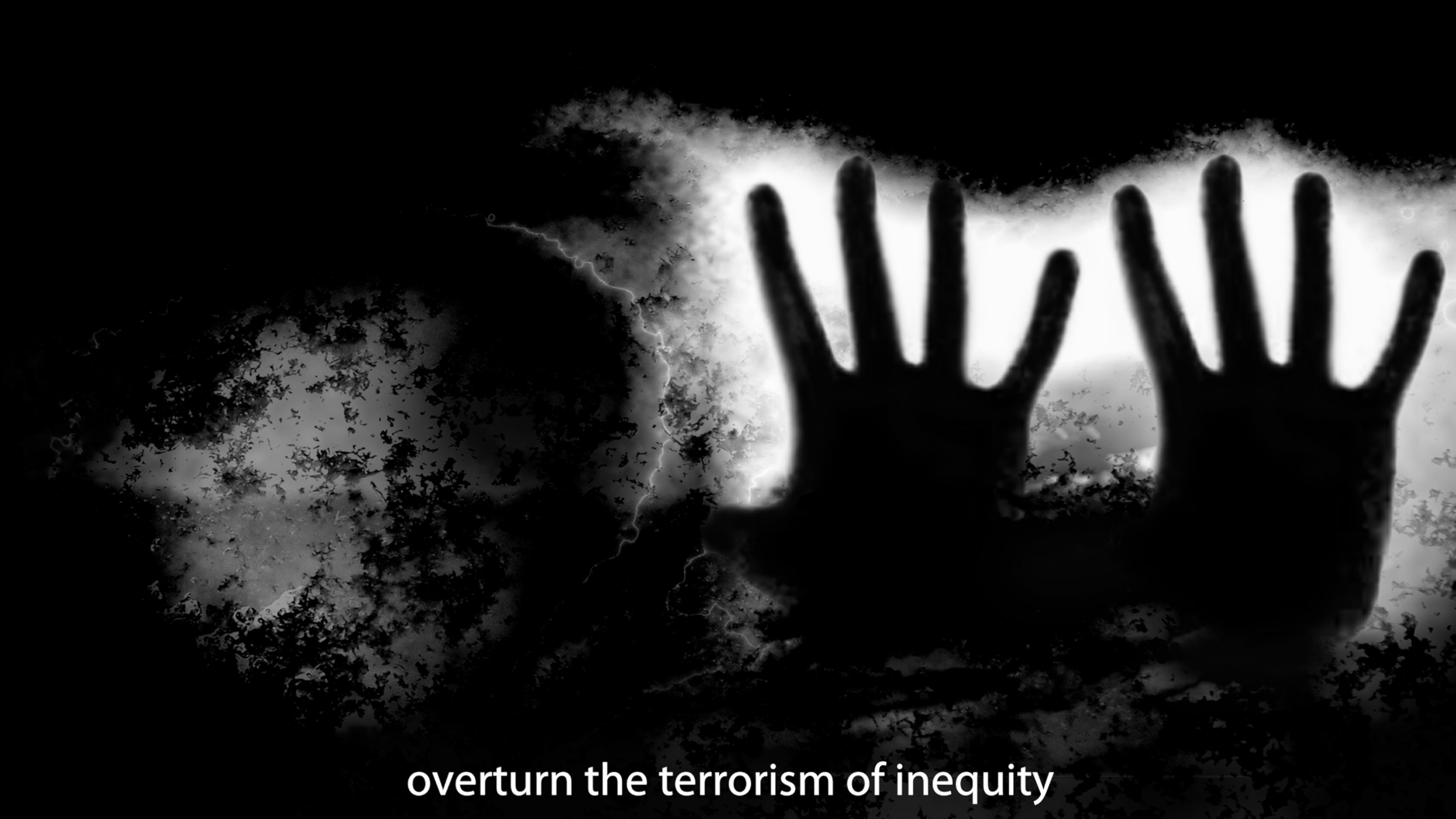
Still from Lis Rhodes,
Ambiguous Journeys (2019).
Copyright Lis Rhodes. Courtesy of the artist and LUX, London.
Lis Rhodes:
I began to use digital for sound editing in the mid 1990s. I found
it was more effective for the detailed work in the composing of soundtracks
than recording and cutting reels of tape. There are perhaps more problems in
the controls that are implicit in the digital software that determines the
visual. I still use early versions of imaging software which I find more
flexible and less predetermining than recent ones. But how I actually make the
original sounds can vary from the construction of piano wires in a cellar for Orifso to combining and rephrasing
digital notes in Ambiguous Journeys.
The physical presence of hands is there – in the making of sound and frequently
in the making of images – the final production is digital.
Nina Danino:
We can think of experimental film as inscribed in practices that
are mostly founded in analogue film practice through an inscribed memory or
embodiment of process. Where do we look for it post analogue – I feel that if
it exists, we have to look for it elsewhere too.
Lis Rhodes:
If we are taking the meaning of inscribe in its original meaning
[in – ‘into’ + scribere ‘write’] then it would mean that I have used
‘inscription’ in both analogue and digital work. This relates to my
understanding of the tension between the image and word – the word as image.
Are the external controls of the digital software more direct than hands-on
engagement with 16mm film? Through the software – probably – through corporate
surveillance – possibly.
Memory is obviously crucial
in all human consciousness – the loss of memory a tragedy. It cannot but be
there inscribed in all work – even artificial intelligence has its prejudices
inscribed.
Nina Danino:
I wonder if from the foundations of a hands-on practice (indeed we
see your hands under the rostrum in Light
Reading) how you approach materiality in your working process now?
Lis Rhodes:
You refer
to my hand under the rostrum camera in Light
Reading. I do not see any material connection between this image and
materiality other than the imprint on the film surface.
My fingers are working back
and forth across the keyboard at this exact moment – less interesting than the
image of the hand itself – but hands on – instructive to the apparatus.
In both the image of a hand
and the instructive use of the fingers is there a tenuous materiality? Is
playing a piano rather than a violin indicative of a loss of materiality? But
in all cases, the instruction to the apparatus is similar. I can’t see how this
varies except in the increased methods of instruction – electronically rather
the mechanical – that doesn’t negate the greater control that is lost to
software.
As an artist much of my work
has been – and still is – in the making of images before any mechanical or
electronic equipment is used – a pencil will do – or indeed a pen.
Nina Danino:
For me materiality can be thought as a way to get to deeper layers
of meaning through process. An engagement with materiality leads to a form of
intensity of engagement but what does this mean, where can one locate it?
Lis Rhodes:
The intensity of engagement is difficult to measure. What affects
one may not another. Feeling is part of thinking but I think that materiality
may be indicative of symptom – not of cause. There is a queue outside the bank
– is the bank about to go bust – or short of staff? The layers of meaning are
degrees of materiality.
Nina Danino:
Ambiguous Journeys and Journal of Disbelief are digital and it will be less obvious as to
where to look for it. Both films use a non-narrative flow of images which are
processed and highly treated, creating a textured aesthetic. Jenny Lund
describes the visuals as painterly, textured, visually rich and tactile images,
moving between sharp realism and grainy abstraction.[33]
The images are highly treated in post-production is that right? Could one think
of digital postproduction itself as an engagement with materiality?
Lis Rhodes:
Journal of Disbelief was made in short sections – digitally – some images were originally painted, others collaged – the writing integrated. There was no post-production. It is a journal. The only post-production in Ambiguous Journeys was a final sound mix with Mick Ritchie. If there is a materiality it is in the monopoly ownership of the means of production by Microsoft, Apple, Adobe etc. They also own the Cloud alongside companies like Amazon, and have all invested huge sums in creating ‘homes’ for our personal data. In a sense, materiality has been transformed into a language that few of us are really familiar with – a pre and post production monopoly. A materiality over which we have little or no control.[34]
Nina Danino:
Is there a process there, a pleasurable engagement with the
material – which includes the digital, for example a later film like Ambiguous Journeys?
Lis Rhodes:
Ambiguous Journeys is a tragedy – the deliberately-made damage done by neoliberal
economics and finance capital – the exploitation and the forced movement of
people from the devastation of war. The material making of Ambiguous Journeys was tragic too.
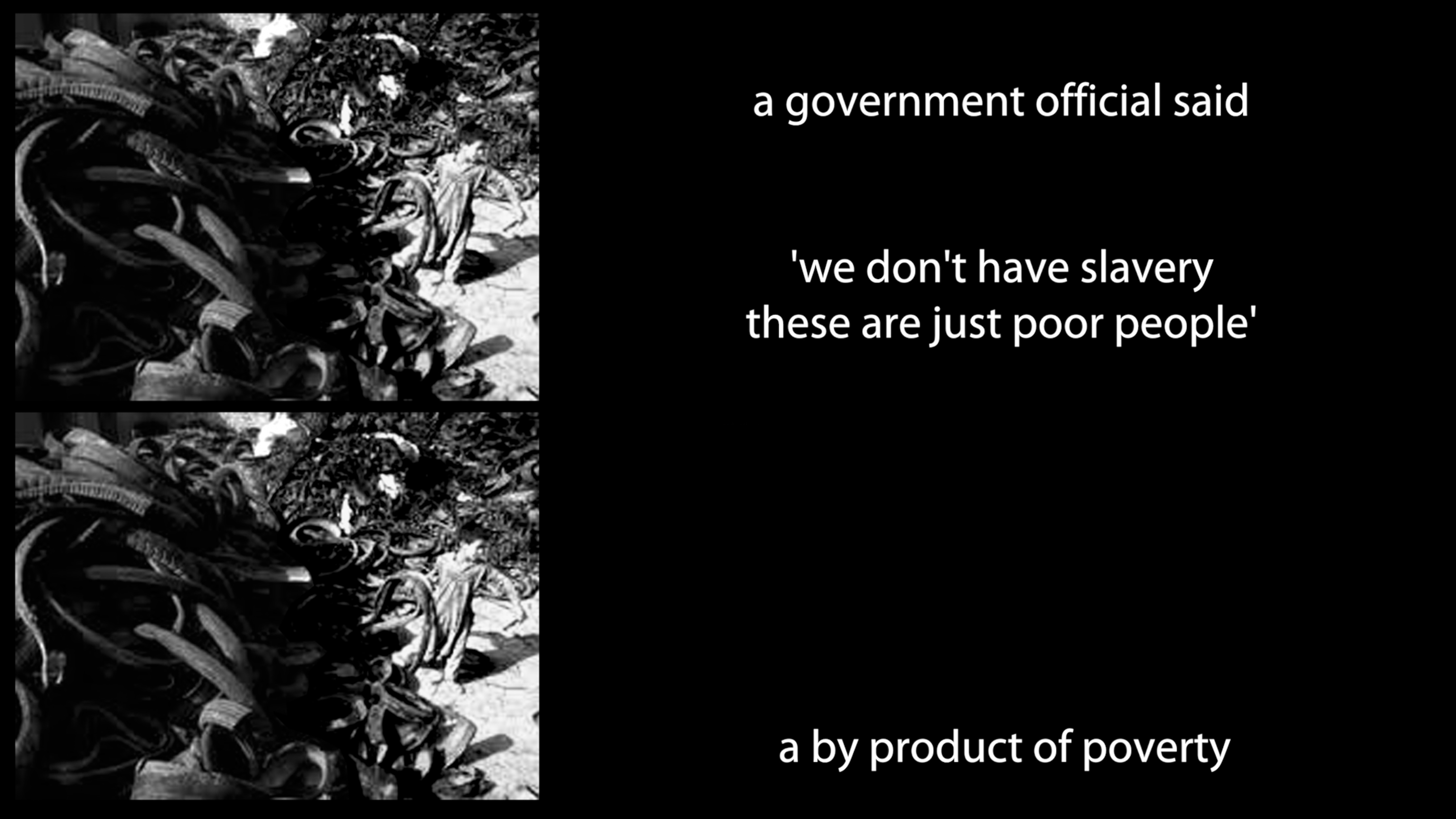
Still from Lis Rhodes,
Ambiguous Journeys (2018).
Copyright Lis Rhodes. Courtesy of the artist and LUX, London.
Nina Danino:
We have discussed the relationship of the means of production:
technology, materiality and mastering in women’s films. How does thinking about
materiality enable you to talk about the subject and object, the her and she
that the writing always refers to. How did you feel these means communicate the
she in vision or obscured from vision? Perhaps we can touch on context of the
London Film-makers’ Co-op [LFMC]. My retrospective construction is that of an
LFMC as the point through which these ideas intersected.
Lis Rhodes:
We talked about this
question earlier. It is certainly present in the exploitation of women – where
vision sees in recognition. Assumptions are permitted in the systematic
appropriation of image. The focus is already framed – before the image is read.
The subject – her image is present in words – the ideology permits their
freedom. The object is forced into being without image. There is no image of
the value of her labour – that has been stolen.
she wrung her hands
round the twisted cloth
and squeezed
the drips that were
to drip down
from their freedom
to wrench their profits
from her labour
[35]
I wasn’t very involved with the LFMC after 1975 or 1976 when I was
running the cinema – and I don’t think that these ideas were being discussed
very much then.
Nina Danino:
It follows that the relationship to material and materiality was
an approach which was developed through the structure of the LFMC in its
diverse manifestations i.e., not just as a physical building or workshop
facilities, but as an ethos and position to film practice as was discussed at
the round table ‘Women of the London Filmmakers’ Co-op,’ and there are
different individual experiences of it.[36]
In the late seventies, who were your peer filmmakers in the film context around
you, who were important to you? Were there particular experimental films that
influenced you?
Lis Rhodes:
It was more the books I was reading – particularly the poets –
that probably influenced the work I was doing. Then in the early 1980s I worked
with Joanna Davis on the Hang on a Minute
series (1983–85) for Channel 4, and with Mary Pat Leece on the initial research
for the film Running Light (1996).
Annabel Nicolson’s Reel Time
performance in 1973 was a transitory moment of great significance.
Nina Danino:
My generation was in the 1980s when the LFMC was a very diverse
place in terms of the work that was shown and different camps using it. You are
associated with the 1970s modernist avant-garde of structural film which is the
first generation of experimental film in Britain, but ‘structural film’ was
diverse too, contrary to perhaps how the scholarship unifies and selects the
history. There are camps and different approaches to it even within the UK and
it also connected to music scenes and to performance in different ways as well
the literary milieus and writing contexts that we described earlier.[37]
The LFMC as an artist-run
collective succeeded in creating a culture for film/video as an art form for
artists and a medium specific practice in the context of avant-garde and
modernist experiments in performance, music and projection as described. Were there
particular artists or filmmakers at the LFMC who influenced how you developed
your thinking about your work?
In your time at the Co-op
cinema in 1975–76 what are your thoughts about your film programming there?
Lis Rhodes:
You have headed this section
on the LFMC as ‘Britain and the LFMC’ – my experience was not quite that. As
cinema co-ordinator in the mid-1970s I was screening work from Germany, France,
Italy and the USA. Sometimes with the filmmakers present sometimes not. I agree
with your remark that scholarship unifies and selects history, and tends to tie
things together categorically. To suggest it was the first generation will
exclude earlier individual artists working in film in Europe and elsewhere. I
think the uniqueness was in the presence of the London Musicians’ Collective
[who shared the same building as the Co-op] and the importance of performance
work to artist and musicians.
Nina Danino:
The LFMC was also a centre of production through the workshop. Is
there an aspect of your aesthetics which relate to the context provided by the
LFMC? Did you make films there?
Lis Rhodes:
I didn’t actually make films at the LFMC – but I did use the
[optical] printer and then Filmatic laboratories to process the prints. Access
to the printer was essential – in the printing of a sound track from split 16mm
frames for Light Music – I don’t
think even Filmatic would have attempted this.
Nina Danino:
The LFMC was also a critical and theoretical space. My connection
with this aspect of it was through Undercut
which in the 1980s played a part connecting experimental film practices,
critical/theoretical writing and artist’s writing. It published artists’
writings and on the work of peers which was different to being mediated by
curators, gallerists and professional critics. Also, it published image and
text for the page – photo pieces as they were known. Your bibliography attests
to your regular writing in different forms for Undercut. Is there anything you want to add to this?
Lis Rhodes:
Yes – I think that Undercut was
a very significant development for the LFMC and thanks to you and Michael
Mazière for all your work as editors.
Nina Danino:
We have spoken about the influence of poetry, artists’ writing but
was this theoretical or critical context also important to you?
Lis Rhodes:
There are many ways of considering theoretical and critical work
and writing on film and art. Some I find very useful – but a quick glance at
the bookshelves a few titles remind – like Review
of African Political Economy
(1984), Women Take Issue (1978), Manushi, In the Shadow of Islam The Women’s Movement in Iran (1982), Women on War (1988), Feminism and the Power of Law (1989).
All strikingly relevant still.
Nina Danino:
In the interview with Jenny Lund you discuss whether making
oppositions between structural/materialist film and personal expressive
filmmaking is problematic in itself and as we can’t get away from the LFMC as a
dominant logos.[38]
You say that you agree, that the oppositional way of viewing is problematic in
its reliance on the conventions of the objective and subjective, and that a
structural/materialist can surely be visionary and personal.
It was a question which was
important in the 1980s too. My experience of the LFMC was that structural film
and positivist approaches were still dominant and there was no place for the
subjective. It was a more purist time, although it was diverse as we have said,
it excluded narrative, representation and the subjective. What were your
feelings in relation to your own position as a woman within the 1970s modernist
avant-garde and the legacy of structural film at the LFMC – was there a place
for it?
Lis Rhodes:
I have
never thought that there was no place for the subjective – as we have already
discussed. My question is simply the divisive proposition that the objective
has a history of expropriation by misogyny. Today this is a known problem with
artificial intelligence – producing algorithms that are from a particular
viewpoint. The theoretical physicist Werner Heisenberg suggested in 1927 that
measuring anything is uncertain – it is impossible to measure anything without
disturbing it.[39]
Nothing is unconditional – the subjective is in continual flux with the
objective.
Nina Danino:
Yet representation was an urgent feminist necessity, so how did you position your work as feminist practice in the debates on representation? Did you feel, as Annabel Nicolson says, ‘that the male modernist avant-garde was a natural ally’?[40]
Lis Rhodes:
No – I don’t think that – but I did think that the positioning of
women was a world wide problem – not confined to the LFMC. If representation
was an urgent feminist necessity then the work I have done tends toward
analysing the causes as to why there is misrepresentation of women – which
certainly needs to be made apparent by as many women as possible – from many
different experiences and times.
Nina Danino:
But there were different positions weren’t there? Some felt it was counterproductive to define cinema by its category women. Some women did not want to be defined by this category. Barbara Meter in ‘Across the Channel and 15 Years’ in Undercut magazine in 1990, argued that women were making ‘just as fine structural films as men’ but she admits that she had experiences which still placed her as marginal.[41]
At the RCA Film School women filmmakers of my generation, Lucy Panteli, Joanna Woodward were trying to marry structural non-representational forms with the need to represent but the subject had to be left out of it and this became again about the male dominated objective means of production. The women’s issue of Undercut in 1985 dealt with this question of representation.[42]
Did you make Light Reading with the
intention of challenging this lack of representation and figuration in the
avant-garde through a female specific perspective?
Lis Rhodes:
I made Light Reading to challenge the structures of language in their
effect on and misrepresentation of women. Would it not be wise to re-think the
grammar that forces the separation of objective to subjective – your question
shows the results of this misogynistic divide. A female specific perspective is
fortunately an unlikely occurrence – women have many different lived lives. I
hope that I write from a perspective of a feminist.
Nina Danino:
Did you want your work to engage with a women’s feminist
experimental film? Perhaps it wasn’t called that.
Lis Rhodes:
I don’t think it was called
that in the 1970s.
Nina Danino:
From the 1980s you taught at
the Slade and at the RCA, including myself. Did you also meet artist Sandra
Lahire at the RCA Environmental Media?
Lis Rhodes:
I began teaching at the Slade in 1978 and the RCA in the 1980s. I
think I met Sandra at Saint Martin’s School of Art and then at the RCA. She
played the piano in Just About Now
(1993). We met and discussed work often until her death. Sarah Pucill – her
partner in the last years of her life – was with her in King’s College Hospital
when I saw her that last time. Maria Palacios Cruz and Charlotte Procter at Lux
have recently digitalised and archived her work, which is very important.
Nina Danino:
In the 1970s to the 1990s, the culture of theory and study
supported my work. Film theory had a big influence on filmmakers – but one had
to interpret it, not just apply it. The key avant-garde film theory was only
Peter Gidal’s theoretical writing as such. However, in the 1970s and 1980s
there was a lot of writing on film theory from the new disciplines of Film
Studies on the Hollywood system mainly. Feminist scholars such as Mandy Merck
and Annette Michelson were writing about women’s films in Screen and Camera Obscura.
Undercut was the only journal
focussing on artists’ experimental film. It provided a connection between
experimental film practices, critical/theoretical writing and artist’s writing
as we said. Critics like Gillian Swanson and Michael O'Pray were in Undercut and also wrote for Screen – so although there were film
sectors there were also connections. Peter Wollen and Laura Mulvey were
filmmakers and theorists. In Britain the theoretical context for film practice
was highly active and these areas of practice created a connected culture of
film, theory and practice, study and so on in the context disciplines of
psychoanalysis, post structuralism, critical theory etc.
There was the beginnings of
the study of woman’s film. Filmmaker and writer Bev Zalcock programmed women’s
experimental films at City Lit (an adult education college in London). The
essay ‘Whose History?’ in Film as Film:
Formal Experiment in Film 1910–1975 (1979) which is republished in your
book Telling Invents Told (2019) is
the locus of invisibility for women. We have spoken about the influence of
poetry, but do you recognise or relate to parts of this context of theoretical
or critical activity which was important to your work?
Lis Rhodes:
I don’t
think that my work was particularly engaged with film studies or film theory.
Teaching at the RCA and the Slade was in response to the work of individual
students (who were making films, videos, writing and performance works) and
group discussions. There were lively women’s groups at both Schools.
In 1975/76 while I was
organising the programmes for the LFMC’s cinema – I screened Marc Karlin’s Nightcleaners (1975) and Derek Jarman. I
seem to remember Peter Wollen, Peter Gidal and Malcolm Le Grice held a
discussion on structural/material and narrative approaches to filmmaking. Camera Obscura also gave a presentation.
Laura Mulvey and I both wrote individual introductions to Lucy Reynold’s recent
book Women Artists, Feminism and the
Moving Image. So, I was familiar with the issues you mention.
Nina Danino:
Did you engage with feminist debates and psychoanalytic theory,
which was dominant to the 1990s?
Lis Rhodes:
Not in the sense that I
think you mean – but this was clearly on my mind as I wrote the last line of A Cold Draft (1988):
the humming grew so loud
that the censors knew
disorientation had to be
diagnosed
she was certified as insane
a traditionally normal act
it happens - here - all the
time
[43]
The
questions of feminism – how and why we think as we do – are never absent in the
making of work. The questions of colonial destabilisation / theft and
neoliberal economics have proved disastrous for women in many countries. During
the 1990s my work was concentrated on the European US break-up of the Federal
Republic of Yugoslavia and the 1991 war in Iraq – as in Just about Now (1993) and Running
Light (1996), which I returned to in the mid 1990s. I returned to the
recordings I made with Mary Pat Leece in North Carolina in 1985 because I
wanted Mary Pat to see the work I made from them before she died. In one of our
recordings – this is spoken by a local lawyer – she said, ‘I mean why is there
slavery? Why are people held against their will if there's not something?’.
The film Running Light (1996) was an attempt to
understand the system that permitted such practices. This of course connects to
Ambiguous Journeys – a terrible
iteration of now – the conditions faced by migrants, particularly those without
papers.
Nina Danino:
The mirror in Light Reading
is a motif which recurs in feminist deconstructive action on the male gaze, for example, the opera heroine in
Thriller (1979) by Sally Potter, which was a big hit.
Were you using point-of-view sight lines in Light
Reading to de-construct the gaze but also ‘to fragment the narrative space
for the purpose of constructing representations of an internal state’?
The theory of the gaze in
cinema and Laura Mulvey’s woman’s ‘to-be-looked-at-ness’ influenced counter
visualities in the feminist films. How did feminist film theory inform your
work? Is the theory of the gaze something that you engaged with? Did you want
the viewer to view Light Reading
through the theoretical framing of the sexual politics of the male gaze? Or is
it to be experienced structurally or to be about perception? Were you wanting
to use the conventions of a visual lexicon to construct or draw us into an
active female gaze?
Lis Rhodes:
As I stress, I was dealing with language – her voice – the
knowledge she carried – unheard. I was surely aware of the critical questions
on female representation. To listen – to hear her – was the reason that only
the voice is heard in the first minutes of the film. This interestingly
prevented it being shown on television. The image in the compact mirror occurs
more than once and represents both genders.
Nina Danino:
The
discussion goes to experimental film culture in the 1980s and 1990s and the
exhibition networks and feminist film and organisations. What was it which made you decide to take the step from formal
structural concerns to prioritise social feminist centred concerns and
political activist filmmaking? What made you move away from the male dominated
LFMC (perhaps the answer is there!) to more social/ist feminist centred
concerns and political activist filmmaking?
Lis Rhodes:
On 30 April
1978, 100,000 people marched six miles from Trafalgar Square to the East End of
London for Rock Against Racism, an open-air concert in Victoria Park.[44]
Many arrived running to catch the performance of the Clash. I was there –
unforgettably so. Obviously, the experience of the Hayward Gallery exhibition –
Film as Film –around that time was
also critical, plainly indicating the need to found Circles. The positioning of
cruise missiles on the [Royal Air Force] RAF Greenham Common in December 1982
moved 30,000 women to surround the base holding hands, and Pictures on Pink Papers was in the making.
Nina Danino:
How did you engage with the
emergent feminist or women’s cinema of the 1970s and 1980s in London? You
became a founder of Circles in 1979 together with Annabel Nicolson and Felicity
Sparrow, to focus on programming and distributing women filmmakers in response
to the lack of visible women filmmakers and produced a catalogue and toured the
programme Her Image Fades as Her Voice
Rises.[45]
The idea of being heard is clear, but is why was the image fading?
Lis Rhodes:
It was so essential that if
there was to be an understanding of women artists’ film, video and performance
work, that we got a distribution network going. As you have mentioned, there
were feminist publishers and contemporary magazines doing similar work in
literature. Cinema of Women was already established. One of the students I
taught at Croydon College of Art was involved and Felicity Sparrow and I had a
very good meeting with COW to talk this over.
The first two catalogues for
Circles were just simple printed pages which we paid for. Then there was a
pamphlet titled Her Image Fades as Her
Voice Rises (1983) to assert the importance of women’s voices. The
tradition of narrative film that Alice Guy initiated in 1896 with her first
film La Fée aux choux, appears to be
drawn from the theatre. She used sets and actors to represent visually the only
form of cultural expression in which women were allowed to play a major part –
the writing of fiction.
Nina Danino:
Why did you position your
work in favour of more political filmmaking rather than abstract avant-garde
and experimental film?
Lis Rhodes:
There is nothing more
political than the deliberate absence of women from history, the structure of
language, economics, philosophy, mathematics and musical composition. Light Music (1975) was made because of
the apparent absence of women composers in European Classical tradition.

Still from Lis Rhodes,
Pictures on Pink Paper (1982).
Copyright Lis Rhodes. Courtesy of the artist and LUX, London.
Nina Danino:
Alison Butler says that
filmmaker Maya Deren turns to anthropology and the minimalisation of personal
identity of her presence on film as an escape from her ‘hall of mirrors’.[46]
This seems to signal a fading of inscription. The personal pronoun is
minimalised in the work after Pictures on
Pink Paper and thus presence of the self. Did you reach a limit as to how
far you wanted to take the personal in order to adopt a more overtly activist
political expression?
Lis Rhodes:
Your question suggests that possibly the personal is separable from as you say, overtly activist political expression – indeed they are frequently forced apart – but the one cannot be divided from the other. This does not mean necessarily that the one is other. I am certain that personal is always present – but in my work the personal pronoun is used as inclusive as I have already explained and as Felicity Sparrow wrote in Her Image Fades as Her Voice Rises (1983) ‘“She” is spoken as a multiple subject -– third person singular and plural.’[47]
she could feel the
contamination
but inquiry is known to be
revealing
the censor would redefine
reason – again
[48]
Nina Danino:
Since Pictures on Pink Paper,
a film I personally like very much because of its sensuality, the voices of the
country women talking and questioning their surroundings which is a local
topography, has receded. Your work since Pictures
on
Pink Paper to your most recent
film is characterised by the dominance of political
activism. Ambiguous Journeys deals
with political topics. Of course these are feminist concerns but do you think
that it needs an inscriptive register to be a feminine language?
Lis Rhodes:
In Ambiguous Journeys
the writing I wrote is literally inscribed in the images – timed to the voice –
punctuated by sound. Whether there is a ‘feminine language’ I doubt. As a
feminist – I work – as best I can – as a feminist.
Nina Danino:
Dissonance and Disturbance is the title of recent exhibitions and of the film of 2012, which frame the curating, interpretations, readings and viewership of the work. In an interview with you, Anna Gritz says that your work ‘is a testament to her enduring desire to reactivate and reinvent cinema as a viable expression of protest’.[49]
Lis Rhodes:
Dissonance and Disturbance was the title of a film
that became the title of an exhibition at the ICA in 2012. Dissident Lines was the title of the exhibition at Nottingham
Contemporary 2019. As the two titles suggest there are lines of resistance to
be heard and seen. I think Anna and I agreed on many things – but I’m not sure
that I have ever quite attempted to reinvent cinema – Light Music is probably the nearest that I’ve got to doing it.
Nina Danino:
Journal of Disbelief is a document of evidence
on social and political events, although for the most part we can’t weigh it up
for ourselves because the data is overwhelming, which is intentional. Do you
see it as a culmination which brings your two strands of politics and aesthetics
together as well as writing? You have written that in ‘Journal of Disbelief which I am writing at the moment it is the
concealment of reproductions that I am concerned with. The redaction of
evidence’.[50]
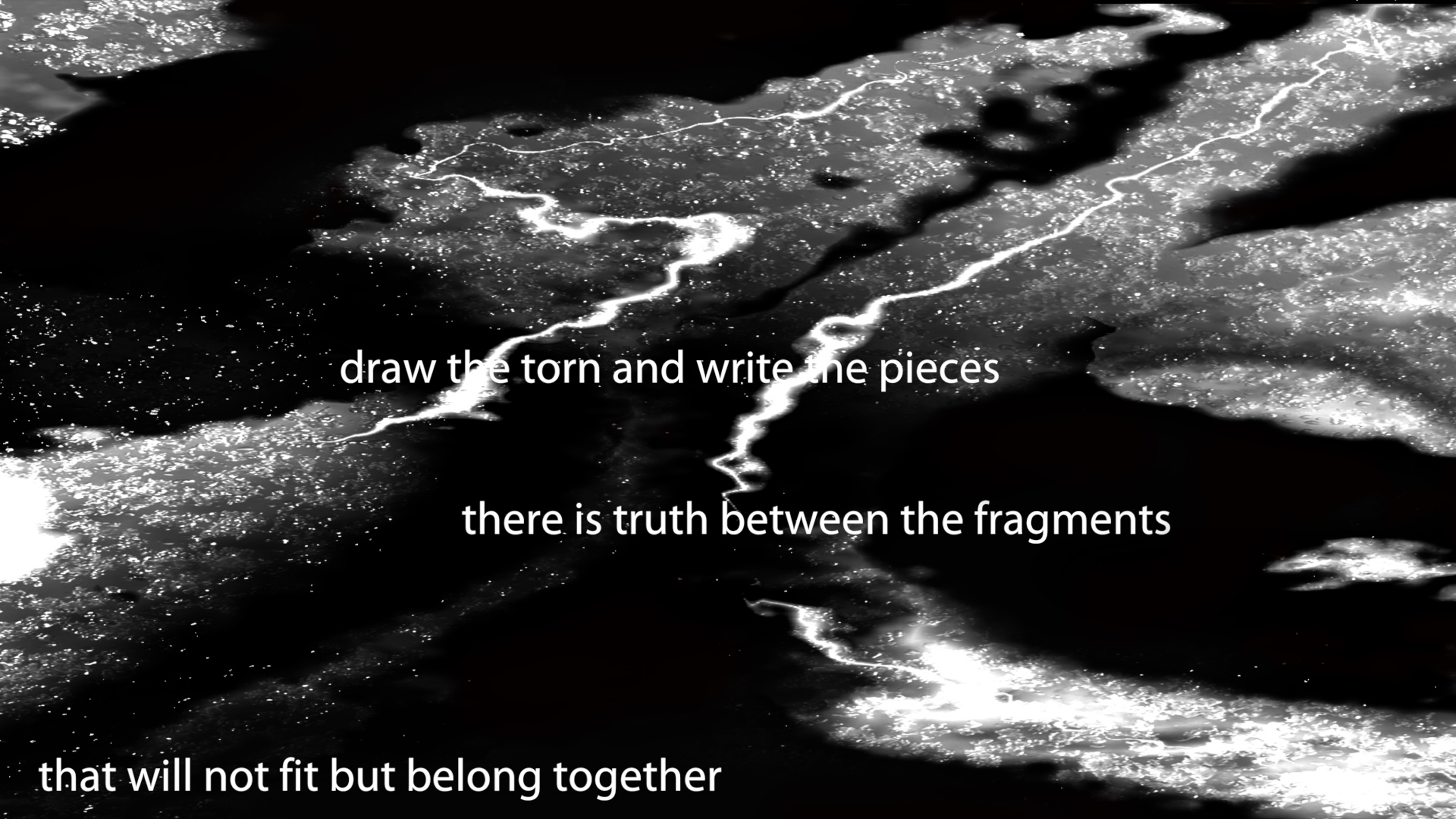
Still from Lis Rhodes,
Ambiguous Journeys (2018).
Copyright Lis Rhodes. Courtesy of the artist and LUX, London.
Lis Rhodes:
In the making of Journal of
Disbelief the problem does lie in ‘the redaction of evidence’. This makes
representation rather difficult – as it is meant to. The number of writers and
journalists who have either been imprisoned or killed is tragic – poets
included, Dareen Tatour was imprisoned for five months for writing Resist, My People, Resist Them:
One day,
they stopped me
shackled me
tied up my body - my soul
my everything…
Then they said: search her,
we’ll find a terrorist
within her
They turned my heart inside
out
my eyes as well,
rummaged through even my
feelings.
– Resist, My People, Resist Them, Dareen Tatour
[51]
Nina Danino:
How do you think of the relationship between politics and
experimental film which can disconnect from real time and place so easily?
Lis Rhodes:
Time moves continually – the
making of anything is historical by the time it is made. There is only a
fleeting glimpse of the unity of time, place and event – that is the moment of
ever moving now. In real time – this sentence is now history.
Nina Danino:
Has modernist experimental
filmmaking given you the political agency you were looking for?
Lis Rhodes:
I don’t think that it is
possible for political agency to be given by any filmmaking. It may or may not
be taken by those who see – hear or read the work. The intentions that motivate
the making of work are not tied to fixed terms of expression. So I don’t think
I was looking for political agency – rather simply to reveal – as best I could
as an artist – the means of oppression and inequity – in the context of the
persistent resistance of women to these conditions.
Nina Danino:
Why chose a modernist form
for something which has social political urgency, why not a more accessible
documentary form?
Lis Rhodes:
I am not documenting the symptoms of division and oppression – it
is the systems themselves that permit and enforce these lived conditions, that
I attempt to articulate.
Nina Danino:
As we are coming to the end, I would like to go back to the
lyrical, where we started. I remembered the hand held camera swaying, filming
the country lanes of Pictures on Pink
Paper which is a lovely and sensual film. I greatly enjoyed seeing it
again. I had not seen it since it was screened at the LFMC (is that right?)
probably when it first came out. This time what came across much more strongly
is the sound and presence of nature, the outdoors, the sea, the clouds and sky.
Pictures on Pink Paper is ‘interwoven
with the images and sounds from places remembered’. Who are Catherine
Terris, Minnie Bunt and Jacky Tillyer? The three
women talking aloud (two sounded similar but from the end credits there are
three voices and your voice). Why did you go to
Cornwall to shoot this film?
Lis Rhodes:
I’m glad you like Pictures on Pink Paper. It was shown in
1982 in ‘Women Live’ at the National Film Theatre (NFT, London) and then at the
Berlin Film Festival in 1984. There are five voices in the film, that is
including mine and Dagmar Krause. I was living in London and needed a rural
place that I knew well. The impetus for the film was the contradictions and
slippages in purpose and intention in the meaning of the words ‘nature’ and
‘natural’ – particularly in their usage toward women. The views from the windows
are in London.
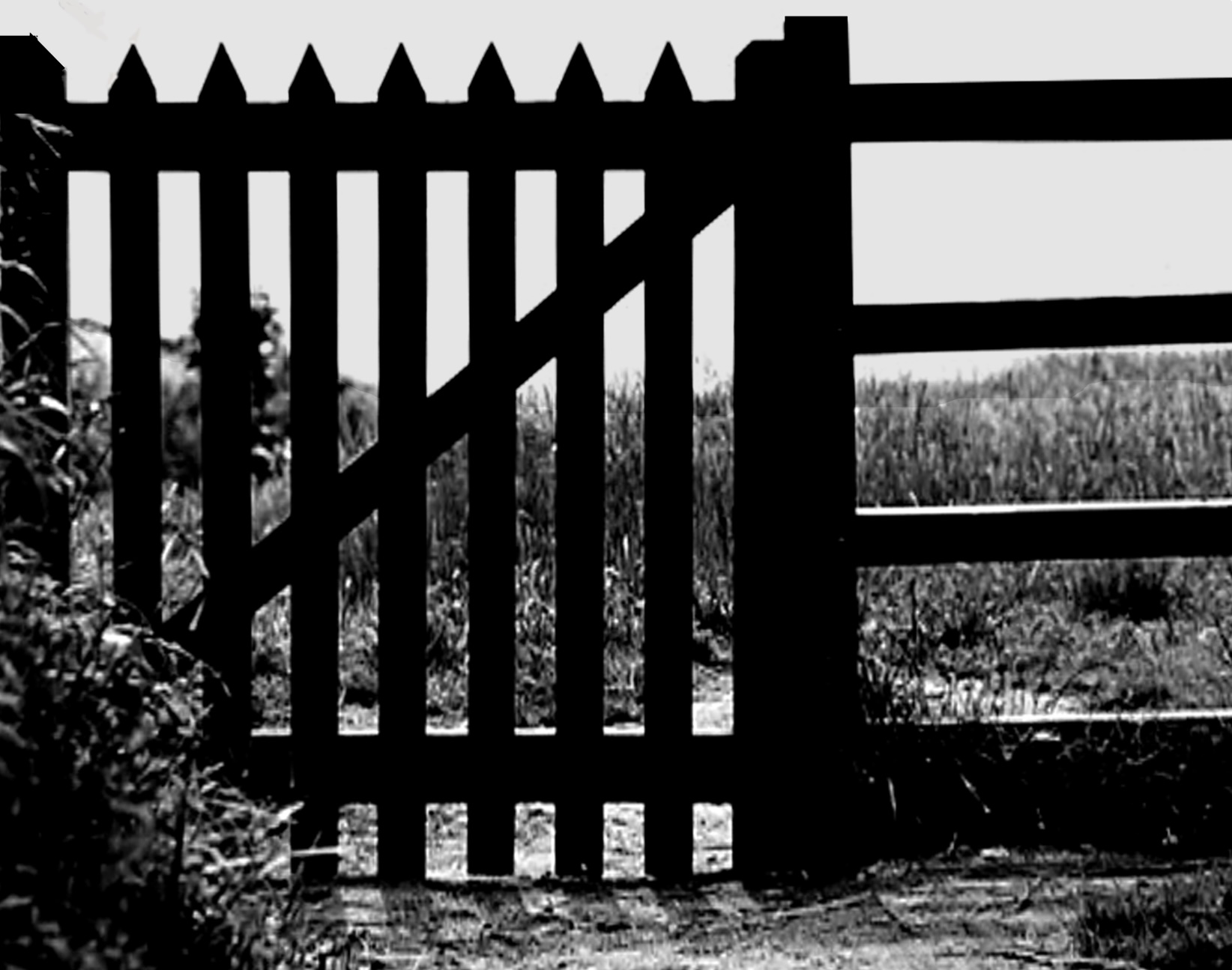
Still from Lis Rhodes,
Pictures on Pink Paper (1982).
Copyright Lis Rhodes. Courtesy of the artist and LUX, London.
Nina Danino:
Funding has always been an issue for experimental film – being out
of the museum means that the work needs to be publicly funded through small Art
Council grants which in my experience have to supplemented by ‘vocation and
devotion’ as Barbara Meter said of the British filmmakers in ‘Across the
Channel and 15 Years’.[52]
How is your work funded now? Is it privately funded or through museum
commissioning for a particular exhibition? Do you make it anyway? Do you have a
continuous studio practice where things feed each other?
Lis Rhodes:
I have been funded with modest grants several times by the Arts
Council – the [British Film Institute] BFI for Pictures on Pink Paper – Channel 4 television workshop fund – The
Hamlyn Foundation (2012) and the Freelands Foundation award to Nottingham
Contemporary for the exhibition Dissident
Lines (2019). I work from home.
As you say I was on the Arts
Council Film and Video panel set up by David Curtis. I agree that it was
important in that it gave bursaries to artists. This I think was significant in
not forcing a completion of a work before the making of it had even begun. I
was also on the Community Arts Committee of the Greater London Council (GLC),
where the funding was orientated to groups rather than individual artists, such
as Cinema of Women, Circles, Women in Sync, London Film-makers’ Co-op, London
Video Arts, Berwick Street Collective – but also to publishers, musicians,
theatrical and photography groups, etc.
Nina Danino:
So to end, I would like to thank you very much for this
conversation and perhaps you would like to choose from these questions below to
respond if you like or if you want to make any concluding remarks.
Did experimental film as we
have discussed it, enable you to speak through a more personal expressive
filmmaking? Did it come out of a personal and subjective necessity and an
intensity or urgency?
Lis Rhodes:
I think that the subjects guided the making of the films –
inseparably so.
Nina Danino:
Do you think we have drawn out some ways of approaching
inscription, enunciation and materiality in these films which represent aspects
of your work?
Lis Rhodes:
I think all these elements may contribute. It relates to a poem I
wrote in 1982 –
this is her letter to the
world
that never writes to her
a world that never told her
that her life would not be
hers
a world that passed a
sentence
on her mother and on her
a sentence never spoken
is the strongest chain to
make
a prison wall of silence
the sharpest stones to break
– Lis Rhodes, Sabra and Shatila 16 September (1982)
[53]
I would like to thank you – and hope that you will bear with me that this is a written rather than spoken response to your questions.
_____________________________________________________
Biographies
Lis Rhodes (born 1942, London) is a
major figure in the history of artists’ filmmaking in Britain and was a member
of the influential London Film-makers’ Co-op. She currently lives and works in
London. A survey exhibition of her career, Lis
Rhodes: Dissonance and Disturbance, was held at the
ICA in 2012. She had a
major survey retrospective at Nottingham Contemporary
Art Gallery in 2019, and her book
Telling
Invents Told was published by the Visible Press to coincide with the show.
Works by Rhodes are held in the collections of the BFI National Archive
(London), Tate Modern (London), Arts Council of England (London), National
Library of Australia (Canberra), Centre Georges Pompidou (Paris),
Österreichisches Filmmuseum (Vienna) and Simon Fraser University (Vancouver),
among others.
Nina Danino was born in Gibraltar. She is a Reader in Fine Art at Goldsmiths, University of London. She studied Painting at St. Martin’s School of Art and Environmental Media at the Royal College of Art, London. She was a member of the London Film Makers’ Co-operative in the 1980s, a member of the editorial collective of Undercut: The Journal of the London Film-makers’ Co-operative (1981-1990) and co-editor of The Undercut Reader (Columbia University Press, 2003). Her films have been shown worldwide and premiered at film festivals and broadcast on television and a retrospective of her work took place at Close Up Cinema, London in 2016. MARIA (2023) is her fifth feature-length film. Her soundtracks feature vocals, singing, readings, narration and music in her own voice and in collaboration with singers and musicians. Her recent work crosses into stand-alone audio, live performance and studio recording.
_____________________________________________________
Select Bibliography
Barthes, R. 1980. Studium
and Punctum. In Camera Lucida:
Reflections on Photography. Hill and Wang, 1980: 25–27.
Braidotti, R. 1994. Nomadic Subjects: Embodiment and Sexual
Difference in Contemporary Feminist Theory. Columbia University Press.
Butler, A. 2002. Women’s Cinema: The Contested Screen.
Wallflower.
Centre for Contemporary
Cultural Studies. 1978. Women’s Studies Group, University of Birmingham. Women Take Issue: Aspects of Women’s
Subordination. Hutchinson.
Danino, N., Matthee, J., Novaczek, R., Pucill, S. and Syed, A. 2015. “Roundtable Discussion: The Women of the London Filmmaker’s Co-Op.” The Moving Image Review and Art Journal (MIRAJ) 4, no. 1–2 (December): 164–79. https://doi.org/10.1386/miraj.4.1-2.164_1
Danino, N. 2003. The Intense
Subject. In The Undercut Reader: Critical
Writings on Artists' Film and Video, eds. Nina Danino and Michael Mazière,
8–12. Wallflower Press.
Dickinson, E. 1975. The Complete Poems of Emily Dickinson,
ed. Thomas H. Johnson. Faber and Faber.
Gidal, P. (ed.) 1976. Structural Film Anthology. London:
British Film Institute.
Gioseffi, D. (ed.) 1988. Women on War: Essential Voices for the
Nuclear Age. Simon and Schuster.
Kiernan, J. 1983/84.
“Reading ‘Light Reading’.” Undercut: The
Magazine of the London Film-Makers’ Co-Operative 10/11 [British Avant-garde
Film Issue], (Winter/Spring): 37–39.
Lacan, J. 1985. Feminine Sexuality: Jacques Lacan and the
École Freudienne, eds. Juliet Mitchell and Jacqueline Rose. W.W. Norton.
Mikdadi Tabbara, L. 1979. Survival in Beirut: A Diary of Civil War.
Onyx Press.
Nottingham Contemporary. “An
Interview with Lis Rhodes,” accessed 9 February 2025.
https://www.youtube.com/watch?v=3A7iLCHqIcU.
Rees, A.L., Curtis, D.,
White, D., Ball, S. (eds.). 2011 Expanded
Cinema: Art, Performance, Film. Tate.
Rhodes, L. 2019. Telling Invents Told, Palacios Cruz,
María (ed.). The Visible Press.
Rhodes, L. 2019. Dissident Lines [catalogue]. Nottingham
Contemporary.
Rhodes, L. 2019. “A Reading
by Lis Rhodes.” Nottingham Contemporary,
24 May, accessed 9 February 2025.
https://www.nottinghamcontemporary.org/record/a-reading-by-lis-rhodes/.
Rhodes, L. 2012. “Lis
Rhodes: Life in Film.” Frieze 149, 19
March, accessed 9 February 2025.
https://frieze.com/article/lis-rhodes-life-film.
Rhodes, L. 1979. Whose
History? In Film as Film: Formal
Experiment in Film, 1910-1975. Arts Council of Great Britain: 119–20.
Rhodes, L. and Lund, J.
2015. “Lis Rhodes in Conversation with Jenny Lund: London, 16 April 2015.” The Moving Image Review and Art Journal
(MIRAJ) 4, no. 1–2 (December): 180–96.
https://doi.org/10.1386/miraj.4.1-2.180_7.
Smart, C. 1989. Feminism and the Power of Law.
Routledge.
Smelik, A. 1998. And the Mirror Cracked: Feminist Cinema and
Film Theory. Palgrave Macmillan.
https://doi.org/10.1057/9780333994702.
Stein, G. 1931. How to write. Plain Edition Paris.
Stein, S. “On 1985.
‘Pictures on Pink Paper’ by Lis Rhodes.” Undercut:
The Magazine of the London Film-Makers’ Co-Operative 14/15 [Special Double
Issue on Women’s Work], (Summer): 62–68.
Tabari, A. and Yeganeh, N.
1982. In the Shadow of Islam: The Women’s
Movement in Iran. Zed Press.
Tatour, D. 2018. Poetry by
Dareen Tatour. Translated by Andrew Leber, InTranslation,
March, accessed 9 February 2025.
https://intranslation.brooklynrail.org/arabic/poetry-by-dareen-tatour/.
Lis Rhodes Filmography (2025)
Dresden Dynamo (16mm, colour, sound, 5 minutes, 1971/72)
Amanuensis (16mm, black-and-white, sound, 8 minutes, 1973)
Lis Rhodes and Ian Kerr, Rumour Shock for the Lab.R (performance
with 2 × 16mm, b/w, sound, 10 hours, 1974)
Print Slip (3 × 16mm, b/w, sound, 10 minutes, 1975)
Rip It Up (3 × 16mm, b/w, sound, 8 minutes, 1975)
Untitled No. 1 and No. 2 (video, b/w, sound, 14 minutes, 1975)
Light Music (2 × 16mm, b/w, sound, 25 minutes, 1975-77)
Lis Rhodes and Ian Kerr, Bwlhaictke (performance with 2 × 16mm,
b/w, sound, 18 hours, 1976)
Lis Rhodes and Ian Kerr, Cut A X (performance with 16mm, b/w,
sound, 18-20 hours, 1976) Music by Cornelius Cardew.
Notes from Light Music (16mm, b/w, sound, 15 minutes, 1976)
Notes from Light Music (16mm, b/w & colour, sound, 25 minutes, 1976)
Notes from Light Music (digital, b/w, sound, 12 minutes, 1976/2014)
Light Reading (16mm, b/w, sound, 20 minutes, 1978)
Pictures on Pink Paper (16mm, colour, sound, 35 minutes, 1982)
Featuring Catherine Terris,
Minnie Bunt, Jacky Tillyer, Mandy Rose. Music by Lindsay Cooper. Sung by Dagmar
Krause.
Lis Rhodes and Jo Davis, Hang on a Minute (16mm, colour, sound,
13 × 1 minute works, 1983–85)
Series includes: No. 8 Bus;
Pink Patterns; Words and Wealth; Pornography; Washing Up; Much Madness; Ironing
to Greenham; Petal for a Paragraph; Windscale, Swing Song; Tyger Lily; White
Words; Goose and Common. Featuring Rose English. Music by Lindsay Cooper. Sung
by Dagmar Krause and Kate Westbrook. Voiceover by Lily Greenham.
A Cold Draft (16mm, colour, sound, 28 minutes, 1988)
Deadline (video, colour, sound, 28 minutes, 1991)
Just About Now (video, colour, sound, 22 minutes, 1993)
Piano played by Sandra
Lahire.
Running Light (digital, b/w, sound, 13 minutes, 1996)
Saw played by Ted Miles.
Orifso (digital, b/w & colour, sound, 14 minutes, 1999)
Riff (digital, colour, sound, 18 minutes, 2004)
STILL (digital, colour, sound, 22 minutes, 2008)
In the Kettle (digital, b/w & colour, sound, 20 minutes, 2010–12)
Dissonance and Disturbance (2 × digital, b/w & colour, sound, 27
minutes, 2012)
Journal of Disbelief (digital, colour, sound, 84 minutes, 2000–16)
Ambiguous Journeys (digital, b/w, sound, 40 minutes, 2019)
Disquiet (digital, b/w, sound, 78 minutes, 2022)