Part 3 (of 6)
Lexicons of Introspection: 16mm, symbolism, editing
Jayne Parker in conversation with Nina Danino (2020)
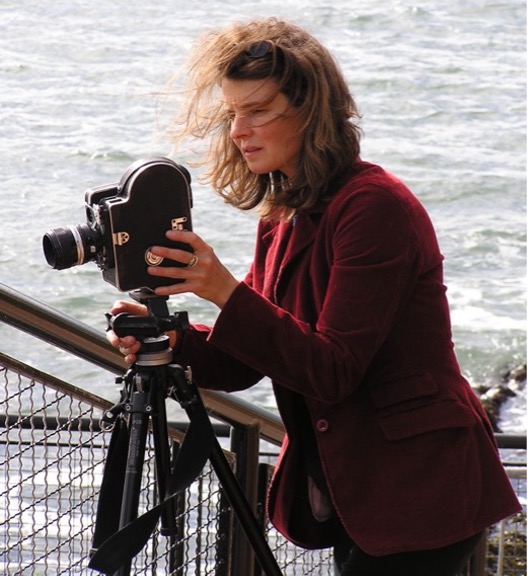
Photograph of Jayne Parker (2003) by
Simon Parker. Courtesy of Jayne Parker.
_______________
Shaped from an online conversation and subsequent emails between the artists during and after the first COVID-19 pandemic lockdown in the UK, this text involves a dialogue between Jayne Parker and Nina Danino. They later revisited their discussion and edited the transcript in 2023 and 2025.
________________
Taking Jayne Parker’s close work with 16mm film as a starting point, the discussion below is contextualised by an essay on the ‘The Artist as Filmmaker’ by writer and critic A.L. Rees,[1] published in the catalogue for a retrospective show of Parker’s work in 2000.[2] It discusses the visual language of her experimental films as a form for dealing with ideas at the borderline of naming through the use of a visual vocabulary.
The conversation examines Jayne Parker’s
chosen lexicons of gesture, symbol, performance and actions. Starting with a
discussion of her film The Oblique
(2018) and with the work in the exhibition Still
Life by Lisa Milroy and Jayne Parker at A.P.T Gallery in London (2018), it
doesn’t go into interpretation, instead it engages with each films’ own visual
language, and the grammar that is particular to them. Their dialogue doesn’t
try to decode the meaning – this isn’t possible, as the signs in Jayne Parker’s
films can’t be fixed. There are oysters, eels, fish and actions such as wiping
the mouth, diving and washing. Often, the protagonist doesn’t speak, she is
silent. Are these works trance-films, quest films, psychodramas? This
conversation explores the language of the films, which is one of precision,
economy, control and focus.
Editing plays a prominent role in Jayne
Parker’s films, in whose work continuity in editing is transferred to
experimental film, where there is a disjuncture that doesn’t conform to the
standard. In this context, the approach of Maya Deren provides an apt parallel.
A filmmaker known for surrealism and symbolism but also for working as an
editor in Hollywood, Deren wrote precisely on the art of editing. In her
writings on creative cutting she says that ‘the function of cutting can be said
to be that of the thinking, understanding mind’.[3]
She
writes that editing creates, ‘the meaning, the emotional value of the
individual expressions, the connection between individually observed facts, is,
in the making of the film the creative responsibility of cutting’.[4]
Editing is not secondary to the poetics of symbols in the artist’s oeuvre, but
this and the wider conversations in this series discuss how it is part of
signification. They discuss visual language as having the impact to convey
intensity in relation to Jayne Parker’s work as part of the precision and
economy of shots, framing, camera and the cut, in order to convey that which
has no ready name.
________________
Please note that the opinions and information published here are
those of the speakers/authors and not of LUX or the wider research team and
institutions involved with their funding, transcription and publication.
Published online by LUX, London (2025)
Editing and research: Claire M. Holdsworth (2020/2025)
________________
Conversation
Recorded 19 December 2020 (Slade School of Fine Art, University College London)
_____
Nina Danino:
Jayne, it’s nice to see you
and thank you for this conversation. We’re at the Slade School of Fine Art
[University College London], where you are Professor of Fine Art.
Your film The
Oblique was shown in the exhibition Still
Life at A.P.T. Gallery. It is shot on 16mm and includes images of white
magnolia flowers against a dark night background. It was shown alongside a
series of black and white photographic prints and photograms. Where does the
image of the magnolia tree come from?
Jayne Parker:
It dates from when I moved
into my present home. In the garden there’s a white magnolia tree and the first
year I was there I filmed it at night. It is one of those images that has
become really important to me – filming the tree at night, it felt as if it was
flowering too late. It felt poignant – and it’s a beautiful tree, a beautiful
image. The magnolia tree has stayed at the centre of my work from then.
Nina Danino:
When was that?
Jayne Parker:
Since around 2001. It didn’t
appear in a film until a bit later. I first used the image of magnolia blossoms
in Stationary Music (2005), featuring
Katerina Wolpe, the pianist. It was the first time I used the magnolia. You
know, when you see those closed buds, it’s like everything is on the inside –
and the bud is also like a flame. I think in all my work, things are what they
are, and then they’re also something else, or they point to something else. It
is an image that has stayed central and is still active. Recently, in the last
few years, I’ve been making a lot of objects, sometimes using magnolia wood.
For several years I collected all the petals that fell from the tree and dried
them. I had this idea I could make paper from them, but the petals don’t
contain any cellulose. They can’t bind together without additional material.
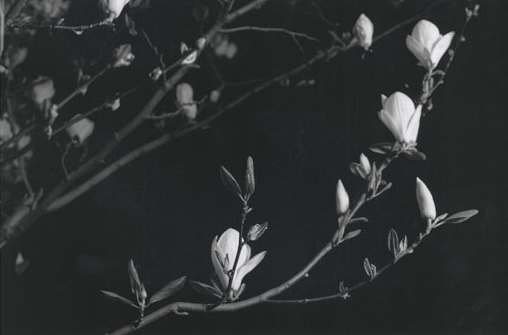
Still from Jayne Parker, Stationary Music (2005).
Copyright Jayne Parker.
Courtesy of the artist and LUX, London.
Jayne Parker:
We’re entering this
conversation through materials and photography, through the physical presence
of the magnolia tree on 16mm film. How did you engage with photographing and
also producing photographic prints from it through photograms and the direct use
of the flowers?
Nina Danino:
For some of the prints I use
magnolia petals as negatives, by placing individual petals in the negative
holder of the photographic enlarger in the dark room, which usually holds the
photographic negative. There’s a direct relation between the actuality of the
tree and the image and that’s important. I’ve made a lot of photogram work with
the petals, and the buds as well – it’s very direct, as well as being one to
one in scale.
For the film Stationary Music, I shot on 16mm
negative. With the photographs that you saw in the exhibition Still Life (2018) there’s no negative
involved, it’s purely the petal itself which is used in place of the negative –
in a way the petal becomes a negative. With the photograms, the magnolia petals
and flowers are laid directly on the photo-sensitive paper. I have quite an
uneasy and difficult relation with photography itself, as opposed to
filmmaking. I always feel I am in danger of deadening an image when I take a
photograph. It’s the sense of movement of film that’s always been so important.
Even if I’m filming something that’s still, it’s ‘in-time’. Standing next to
the Bolex camera and counting the seconds of film footage as they run through
the camera – there is something about the act of filming and duration that
creates meaning.
Jayne Parker:
The writer and critic Al
Rees writes in ‘The Artist as Filmmaker’ – which was published in the catalogue
for the retrospective show, Jayne Parker
Filmworks 1979 – 2000 at Spacex Gallery in Exeter in 2000/2001 – that the
films ‘deal with sensations and ideas at the borderline of naming’ which
suggests a subjective aspect.
Nina Danino:
That catalogue accompanied a
Film and Video Umbrella touring show, co-commissioned with Spacex Gallery, and
accompanied that exhibition.
Jayne Parker:
It would be good to discuss some of your films through ‘their own subjective routes’ – K. (1989) is a kind of self-portrait.[5] In K. you’re facing the camera naked and perform a knitting act with the heavy entrails of an animal. You had previously done performance to camera in Almost Out, in 1984 where from memory, you perform naked also standing but in a video suite and conducting a series of exchanges of possibly unanswerable questions and declarations to two other participants who engage with you. One is a middle-aged woman who is also standing naked and patiently answers you standing in the glare of a studio and the other is a man who is clothed and appears in a two-shot with you in the video suite. These interrogations and exchanges take place over a long period of 100 minutes which makes it a durational video work.[6] I posed formalist questions to you about this video for Undercut special issue on women’s work.[7] The LFMC included critical confrontation and questioning but from a position of careful consideration of the work. 16mm has been your main medium of practice and K. is a 16mm film where you film yourself performing to camera. What made you take that step in K.?
Jayne Parker:
It was just pragmatic
really. I couldn’t find anybody to do what I wanted them to do. In that film
it’s as if I’m taking out my intestine, eviscerating and knitting it (using my
arms). I was symbolically taking things out that I felt weren’t mine and then
making a new order through knitting. It’s a very literal film. In fact, a lot
of the films are very literal; they are exactly what they are. I knew I could
do it. I wasn’t fazed by dealing with the intestine, although it was
challenging. It was because of not finding somebody to do it, that I was in
that film.
Nina Danino:
How did you prepare for the
performance?
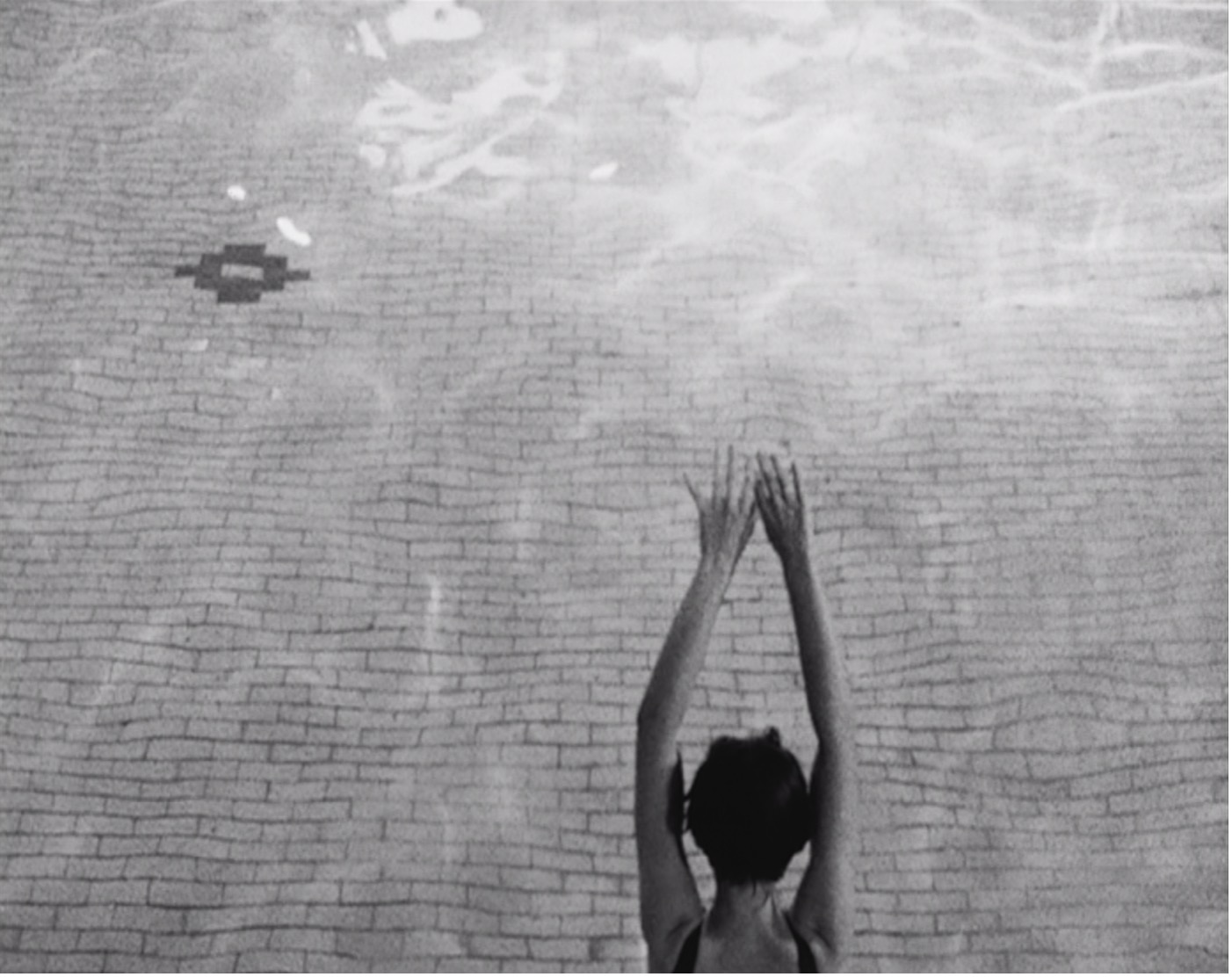
Still from Jayne Parker, K. (1989).
Copyright Jayne Parker.
Courtesy of the artist and LUX, London.
Jayne Parker:
I always prepare a lot
before filming, although recently, maybe in the last decade, if I’ve wanted to
film something I’ve just filmed it. Now I have a cupboard full of film that is
waiting to find its purpose. It’s like I’m hoarding in a way and that’s not
good: it’s potential without becoming something. I’m slowly working my way
through it, finding a way to bring structure to it. I would always plan before
I filmed something. I’d take still photographs with a 35mm camera and later
used a small video camera, although that could be problematic as the video lens
on a camcorder rarely equated with the parameters of 16mm prime lenses.
I never had a storyboard but
I did have a list of shots I wanted to film. I could never imagine how
something would go together until I was editing it, until I saw what the
material could do. So, I made sure I covered everything, in order to give
myself choice with the edit. It’s not a very economical way to work but I’m not
very good at visualising something until I see it. In fact, I’m really only
filming things that I’ve seen or think I’ve seen, rather than something that
has been constructed purely from the imagination. Through editing, the images
and actions are put in relation to each other, and that’s where the leaps can
happen.
Nina Danino:
You mention ‘finding a way
to bring structure to it’ for K. The
camera is on a tripod, it is very precisely shot for editing so that your
actions can be reconstructed. Maya Deren calls this ‘shoot to cut’. She sees
this as an essential part of economy, both so that shots aren’t wasted but also
economy of thought by having ‘the final cut version of the film in his (sic)
mind’.[8]
There are two parts. In one you perform the knitting of a garment with the
intestines of a cow and in the second
part you are seen diving several times into a public pool. Both are shot on
16mm in black and white. Do you work with the final version in mind?
Jayne Parker:
The two parts were always
intended to go together. For me, part one was about taking something out in
order to make space for something new and part two was entering into a new
space – or attempting to enter into a new space. I saw them very much in the same
light, one naturally following the other. I remember doing a test with colour
film to see if it would work well in colour. The test in itself looked very
beautiful. The intestine was a soft grey-pink, with white fat. But that made it
look more like a horror film, and I wanted to take any horror or disgust away
from the image with the intestine. I wanted the action to be something that I
could just do, just like that; as if it wasn’t a big deal to do it.
Nina Danino:
In K. were you thinking about yourself as a performer to camera?
Jayne Parker:
I was just doing the action.
I wasn’t particularly thinking of myself as performing to camera, although of
course I was aware of the intended framing.
Nina Danino:
Where did the choreography
of the actions for the camera come from?
Jayne Parker:
They came out of the action
itself and I was just carrying out the action as well as I could, for example,
in K. I was just knitting. With the
people that I filmed in my earlier films I was drawn to them because they used
their hands very well and I knew that whatever I asked them to do they would do
it in an adept or particular way. It is the same with the musicians in later
films. There’s a quality of concentration that intrigues me and I want to be
where they are when they’re playing or performing. There might be gestures that
they do that are unconscious. It was interesting filming the musicians because
they would usually make the same gestures at the same points in the music.
I find nuance really interesting and that’s what has
always drawn me to people, to their presence when they do things. I think one
of the difficulties of being in my own films is that I also want to be behind
the camera. But I can plan for it. However, people don’t see things like you do
yourself, and that can be difficult sometimes. One of the main things that came
out of being in K. was the importance
of witnessing myself doing things and doing things that I found difficult or
challenging, like the diving, that wasn’t easy. I had to make myself do it.
Working with the intestine was difficult too. It was heavy and incredibly cold
because of course it had no life in it. I think there are physical challenges
that affect the way I do things or perform. If something is heavy you will see
the effort.
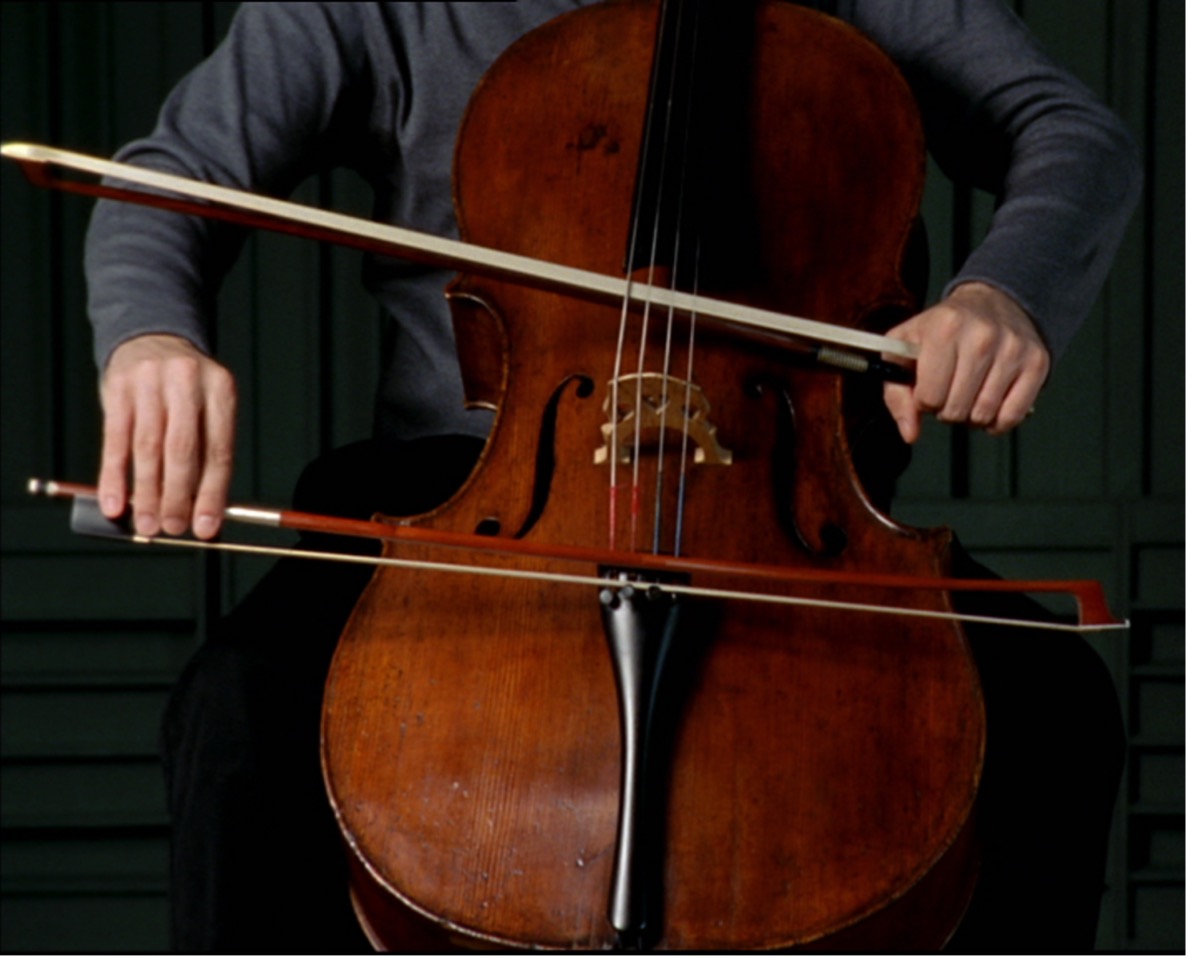
Still from Jayne Parker, Anton Lukoszevieze in Blues in B-flat (part of Foxfire Eins) (2000).
Copyright Jayne Parker. Courtesy of the artist and LUX, London.
Nina Danino:
Were you interested in films where the filmmaker is in them as a character or performer such as in ‘Symbolist’ films (as Rees discusses in the catalogue essay) or taking a ritualist aspect in the quest film or the trance-film such as Jean Cocteau’s Blood of a Poet (1932).[9]
Jayne Parker:
Yes, I’ve always been
interested in such films. I first started making films as an undergraduate
student at Canterbury College of Art where I was taught by Pierre Attala, who
was a great teacher and a strong influence. Filmmaking was part of complementary
studies, it was programmed for half an afternoon a week. It was the first time
I met somebody who didn’t ask me why I wanted to do something, but just said
“Oh, let’s see, how can you do that?” It was very facilitating and liberating.
Nina Danino:
Would you like to say more
about him?
Jayne Parker:
As I remember, Pierre’s
expertise encompassed filmmaking, theatre and writing. He had a scientific
background and a great interest in expression, a broad and rich knowledge base,
which was practical as well as intellectual. I considered him a good friend and
mentor, an important figure, both while I was at college and in the following
years.
Nina Danino:
He’s the interlocutor in Almost Out, is that right?
Jayne Parker:
Yes. We worked on that
together, on those two videos, Almost Out
(1984) and En Route (1986), they were
made in collaboration. Probably, everything that I think about film, comes from
my time as a student at Canterbury College of Art.
Nina Danino:
You have always acknowledged
him as a key mentor and influence in your work of the time.
Jayne Parker:
Yes. There were three of us
who went to those film classes. Claire Winter, a fellow student, was one of
them, she appeared in my films Free Show
(1979) and RX Recipe (1980) but I was
the only person who continued making film in my year. For me, not having to be
good was another aspect that was important, because I always felt I had to get
it right and here was a situation where I didn’t have to prove anything. Even if
something didn’t come out very well, there was always a way to work with the
material – it fostered a good attitude. Thinking about it now, Pierre’s
scientific background brought a different discipline and approach, which was
very liberating.
Nina Danino:
Did Canterbury have 16mm
film facilities?
Jayne Parker:
Yes, there were basic 16mm
film facilities. I remember there were three 16mm cameras, one of which was a
Beaulieu. The editing was picture only and done at a desk with a Murray viewer
and two re-wind arms. There were 16mm projectors and I recall adding the sound
directly onto the magnetic strip of the final print through the projector. The
very first film I made was about someone living in a greenhouse. I took the
camera back to Nottingham and filmed in my Dad’s greenhouse. For some reason I
thought that the tripod could only move at right angles, left-to-right or
up-and-down – I didn’t realise I could move it freely, for instance that I
could follow something. I don't know what happened to that little bit of film,
but it's the very first thing I ever did – I would like to see it again now.
Then there was a film called Show Them a
Leg and The Trumpet Quivers, (1978) which was followed by In Some Rooms it Didn't Matter if I was
There or Not (1978), neither of these films are in distribution. Free Show (1979), I Cat (1980), RX Recipe (1980)
were all made in Canterbury and are held in the archive at LUX, who distribute
them. I made I Dish (1982) and Snig (1982) at the Slade, where I
studied after Canterbury.
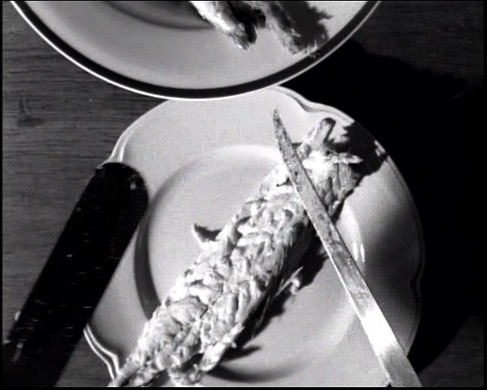
Still from Jayne Parker, I Dish (1982).
Copyright Jayne Parker.
Courtesy of the artist and LUX, London.
Nina Danino:
Can you talk about how you
developed the symbolist vocabulary of the films you made at Canterbury and
later? Snig, I Cat, The Cat and The Woman,
A Cautionary Tale (1987), RX Recipe.
They're populated with creatures, cats, fish, eels. With actions and gestures
of eating, bandaging, washing and actions made by collaborators and performers.
Jayne Parker:
I can try. When you asked
that question, I remembered reading a book about fish, while I was a student in
Canterbury. In this book, I can’t recall the name of the book, it said that
fish didn't experience pain because they didn't have the part of the brain that
corresponded to the human experience, which even then felt unfounded and
untrue; fish do experience pain. Also, I had ideas about fish being in the
earth, and things not being in their usual place, and I think that has probably
continued – things being out of their usual element. For instance being
underwater in Crystal Aquarium.
Nina Danino:
You do startling things like bandage them or take care of these creatures that […] seem to belong to a personal bestiary.
Jayne Parker:
Yes, or creatures that are
dead but are somehow still being treated as if they’re alive, for instance the
conga eel in RX Recipe. The film is
based on a recipe from the culinary classic Larousse Gastronomique. In the film, there's nothing the eel can do to fight
against its condition – I think of it as inert and being force fed. It can't be
[…] I don't know […].
Nina Danino:
It can't be animated
Jayne Parker:
Yes, it can’t be animated.
The eel is an image that can be taken as a sexual or bodily reference, either
symbolically or through standing in for the body. It is out of proportion
because of its scale. There is a wryness there. Incidentally, the conga eel was
lent to me by a fishmonger, who took it back and smoked it after the filming.
Thinking of this now, it adds to the awfulness of the eel’s condition.
Nina Danino:
You hold the eel and you
caress it. It is unsettling and at the same time cryptic.
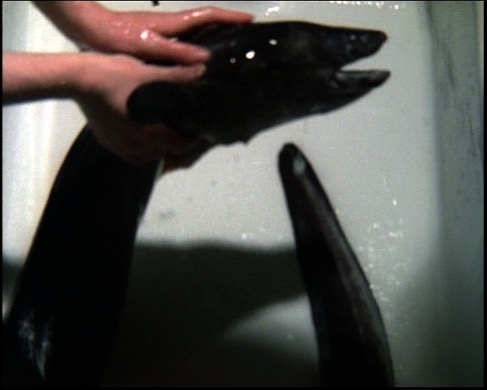
Still from Jayne Parker, RX Recipe (1980).
Copyright Jayne Parker.
Courtesy of the artist and LUX, London.
Jayne Parker:
There is something about
absurdity and the unexpected at play, and also the beauty and strangeness of
creatures. For instance, the live conga eel in The Pool (1991), there is something about the way its gills open
and close in the footage. It is mesmerising. I mean they are terribly fierce
creatures. I read a lot about eels and their journeys, about elvers and other
types of eels, and the fact that no-one had ever seen them mate, although it is
known that they mate in the Sargasso Sea. I became very interested in the
hiddenness of this, the mystery, not everything can be known, but this was over
thirty years ago. Perhaps it isn’t a mystery now […].
Nina Danino:
Were you wanting to develop
your own symbols? Could you say something about that?
Jayne Parker:
I think I really liked
using, and still do, an image that is exactly what it is. For instance, an eel
is itself, but can also be seen as a symbol. It depends what's happening to it
in the film. If I film a fish, it could be male or female, depending on what
the image is and how it’s placed in the film, so you can never be sure about
what you're seeing, or where it's going to take you. It's quite a line to try
and walk, between something that's so obvious and yet is working to define its
own meaning.
Nina Danino:
Shifting its meaning and
given symbolism.[10]
Jayne Parker:
Yes. If I think about it
now, I think of it as a refusal to be defined. Images can be very slippery,
they don’t always do what you think they are going to do. You can’t assume
meaning. Even with the intent to make a film about a certain subject, when you
get the footage back it is as if you are seeing it for the first time. I've
never wanted to make imagery do something, rather I want to be open to what it
is.
Nina Danino:
Are you discovering how far
you can take images, also not trying to impose too much on them?
Jayne Parker:
Yes, often I might be doing
things in order to confront something, to try and see something, to try and
make sense of something, to find meaning. I think it's that third thing that
emerges when you put two images together. It is something that can't be said
verbally, that can't be articulated, that carries the meaning.
Nina Danino:
Symbols are fixed signs, but
an eel could be a phallic symbol or it can be a metaphor for something slippery
like meaning. But if they are cryptic, they need to be unlocked and we might
not be able to read them. Is it about finding a symbolic language on that
borderline which keeps an open communication where it communicates to the
viewer also?
Jayne Parker:
Yes. When I think about
films I’ve seen where I resist engaging, it’s those where, as a viewer, I'm not
given any space, where no stone is left unturned, for me to actually enter into
the film, to be stunned by an image, or to enjoy the experience of not knowing.
Nina Danino:
At the same time, the films
seem to be communicating something urgently that is not directly communicable –
a certain introspection. Yet there is a lot of control in this language, in the
precision of performed actions, framing, editing, therefore they also
communicate through this language of precision in how you film objects,
gestures, actions. Al Rees points out that ‘psychodrama grew as an avant-garde
genre’[11]
where the artist is the protagonist in their own film and performs rituals or
roles to explore and gain interior insights into themselves such as in personal
quest films mentioned earlier.
Jayne Parker:
There are many films I like a great deal that I have seen over the
years, for instance the films of [photographer/filmmaker] Jean Painlevé, and
particularly [artist and filmmaker] Maya Deren’s At Land (1944). Also Robert Bresson’s films, his film of Cocteau’s
script Les Dames du Bois de Boulogne
(1945) and the films of Carl Dryer particularly Odette (The Word) (1955) to name but a few.
When I was at Canterbury
there was a film club and we saw art house movies, but no experimental films. I
managed to write my dissertation on the artist Andy Warhol and his films,
without ever seeing an Andy Warhol [artist] film. I read about them. I remember
going up to London to see Eraserhead (1977)
by [director and artist] David Lynch. I actually didn’t see any experimental
films until I was at the Slade where I was lucky to be taught by Chris Welsby
and Lis Rhodes and I started going to the London Film-makers’ Co-op [LFMC].
In 1984 I was awarded a
fellowship at North-East London Polytechnic. Filmmaker David Parsons was
running the film area then, and the artist John Smith taught there. Al Rees
came in every Friday afternoon and showed films. It was wonderful because he
just showed them. We just sat and watched films for a couple of hours. They
weren’t heavily contextualised or introduced. We watched and watched and
watched and that was very inspiring. I saw a lot of films then.
Nina Danino:
Was there a particular film
or films that stayed with you or became important?
Jayne Parker:
I particularly remember
Steve Farrer’s Ten Drawings (1976).
That's always stayed with me. It demonstrates so beautifully how optical sound
works and the relationship between the drawn and its corresponding sound, and
how a film can be made without a camera.[12]
I think there is something too about the process of the film’s making from the
rectangular drawing to the linear film strip that captivated me – it made me
think about structure.
Also, early films by Kenneth
Anger, in particular Fireworks (1947),
and early Brakhage such as The Way to
Shadow Garden (1954) and Mothlight
(1963). When Al [Rees] screened Mothlight
at NELP [North East London Polytechnic] the film print was passed around so we
could see the images of the moth wings and seeds that Brakhage had laid along
the original film stock to make the film. Often things I remember hold a
reference to the materiality of film. Another example of this is Malcolm Le
Grice’s Yes No Maybe Maybe Not (1967) where both the film negative and
positive are superimposed, producing a cross-over area – as in a Venn diagram.
I like to think of this third space, where there is neither positive nor
negative.
Nina Danino:
They would have been shown
on 16mm.
Jayne Parker:
Yes. That was the first time
I really began to see things. Then of course being in London and going to the
London Film-makers’ Co-op [LFMC]. In retrospect I can see that the films I
remember, that stay with me or that I admire, are often the ones where I am
drawn to the makers’ ways of working, ways of thinking. Often, it's the way of
thinking. I like structuralist film for the ideas. It's that which attracts me
to experimental music too. Not because I necessarily get pleasure from
listening, it can be very challenging, but because of the way the composers
think about structure. Even though my films don't obviously explore structural
concerns I like to think about such things, particularly in relation to the
materiality of film.
Nina Danino:
The London Film-makers’
Co-op [LFMC] was diverse in the eighties but structural film from the seventies
was strong with its focus on the material of film and on film as medium
specific practice.
Jayne Parker:
That reminds me – I think
things are coming back as we are talking. When I was at the Slade, and I might
be getting dates wrong, I always felt out of step with what was happening
within film, with structural filmmaking and the New Romantics.
Nina Danino:
The LFMC cinema in the
eighties showed lots of different works by artists but there was a trend
towards Super 8 by artists like John Maybury, Cerith Wyn Evans and others who
were connected to the Co-op such as Cordelia Swan, Jo Comino. There was a group
who associated themselves loosely as New Romantics. It seemed to capture the
imagination of artists. Michael O’Pray’s writing championed it. In the eighties
there wasn’t new writing on experimental film and the avant-garde as a
movement, as Michael O’Pray realised, had ended. So, experimental film exploded
into different modes but it had no over-riding theory as the previous
generation had had. Michael O’Pray wrote about the dominance of aesthetics in
film and curated video programmes.[13]
Pandaemonium was curated by Michael
Mazière. But round about 1988 the YBAs began to exhibit in the London art scene
[Young British Artists]. In the nineties, Michael Mazière describes how the two
camps never connected despite the critics’ and curators’ efforts.[14]
Some of those artists connected to the LFMC, some peripherally, but some
closely, moved into the gallery.
Jayne Parker:
I felt I didn't fit in; I
didn’t relate to the ideas. And I was shy. I felt outside, whilst wanting to be
on the inside. I didn't use the LFMC facilities because it took me so long to
film anything that I didn't want to take a risk with the processing in case
something went wrong and I lost the film. I just wanted to take my film to the
lab. In many ways the films for me were made in the editing and I needed the
negative development to be guaranteed.
Nina Danino:
That's right, because at the
LFMC you could use the processing machine yourself or it depended on who was in
charge of doing it, Peter Milner was a very good lab technician, the baths were
run on certain days of the week but it could be unreliable because the bath
might not be run and if you needed your rushes for a deadline it was better to
go to the professional laboratories such as Filmatic on Colville Road. Also,
there was always that concern that if something did go wrong for example,
under-developing the negative because the bath developer had been used too
often or if there was some technical accident you could lose irreplaceable
footage and it was the risk you took.
Jayne Parker:
Exactly. When I found
filmmaking – I was studying sculpture at Canterbury and felt that I couldn't
imbue objects with the meanings that I wanted them to have – there was
something about film that offered this way of working where you could have
multiple strands, imagery, and things could have […].
Nina Danino:
Jayne Parker:
Yes, levels of meaning. For
the first time I felt that, even if I edited something and I didn't include a
shot, it was still there. I didn’t lose anything. There was something about it
still being there even if it wasn't present in the final edit. Working with
film allowed me to imply meanings that I couldn't manage to do through objects
or sculpture. It was this that was liberating for me, the tools of filmmaking
were liberating.
Nina Danino:
Could we then talk about
those tools of filmmaking and your particular film language?
Jayne Parker:
Yes.
Nina Danino:
They're not just tools,
they’re your vocabulary and they’re your language.
Jayne Parker:
My aim is to capture what it
is that I see or think I see, and I don't want to dramatise it through art
direction.
Nina Danino:
You use a static camera,
there are frontal shots and side shots, close-ups, the use of the tripod, the
frame is emphasised. There is a strong sense of the edit and the construction
of making a film. Also, what was it about the 16mm film gauge, because we were
working at a time when video was an option.
Jayne Parker:
I like the fact that there's
a negative. I always film on negative. I have never used reversal. I never used
Super 8 either [8mm film] because I wouldn't have been able to change my mind
when editing without damaging the material. That's what's so wonderful about
the cutting copy, being able to keep track of every single frame.[15]
I'm very good at organising film – not in tidying up a computer, I can't
organise anything on a computer very easily. It's just that I need to see it; I
need to have the material laid out. I used to love the fact that on this strip
of film was the shot of an action, or on this strip of separate magnetic tape
was the sound.
Nina Danino:
The physicality?
Jayne Parker:
Yes, the physicality. It
stays with me, that way of thinking, through the Bolex, through the camera,
through the shuttering, the adjusting of the aperture depending on how much
light there is, and the effect this has on the depth of field, on what is in focus.
I have made works using video, and when I think back I really like the quality
of early video. With the digital there's a lack of substance to it and I find
that troubling. I tried to make the leap into the digital, like a lot of
friends or colleagues have done, but for me it doesn't hold much interest as a
medium itself, although I often finish films digitally because of the sound.
The sound quality of a 16mm film print isn’t subtle enough to adequately
reproduce music that uses a wide dynamic and tonal range. Digital shooting can
be such a slippery medium and inclined to excess. You can just keep on
recording, producing hours of imagery; whereas the economy of film means having
to anticipate something, not knowing what it's going to be like until you get
it back.
Nina Danino:
Well using 16mm imposes a
structure also because the 16mm film roll is limited to either 100 feet or a
maximum of 400 feet at a time which is either is 3 minutes or 10 minutes. This
determines and places a limit to how you plan and organise the filming, whereas
in digital you can film for hours.
Jayne Parker:
I think it's that structure
that really excites me and to be able to try and make something that is
faceted, that has a lot of different aspects or strands. I think of the films
as faceted objects.
Nina Danino:
Yes, 16mm does have a
physical reality as an object.
Jayne Parker:
Yes, absolutely.
Nina Danino:
When I programme a 16mm film
screening at Goldsmiths, it needs a lot of paraphernalia, the film split
spools, different sized film cores, the film splicer in case the film snaps, a
cloth to clean the film. The 16mm cutting room had a set of beautifully engineered
and designed working tools and equipment. I still have my manual 16mm pic-sync
viewing machine although I sold my Steenbeck to Sarah Pucill in the nineties.
Jayne Parker:
I still have a ‘film room’
at home with a Steenbeck and pic-sync, both of which I use for editing. I've
always enjoyed the act of working with film, handling film and being adept with
it, using the equipment, working on the Steenbeck, running the film back and
forth, cutting the film.[16]
Nina Danino:
I love the rhythm of editing
on the Steenbeck which uses the whole body to feel the pace which you don’t
have with digital which is only one finger. I edited Sorelle Povere Di Santa Chiara (2015) to fine cut on the Steenbeck.
Let’s talk about the camera and filming on 16mm. The earlier films are shot on
16mm stock, and perhaps you used a fast film as they are filmed in interiors
and are lit and the image is full of contrast and grain.
Jayne Parker:
In the early films when I
first started using 16mm I never felt I had a problem with depth of field,
probably because I used a high rated ISO film that was more sensitive to light.
The more films I made the less depth of field I seemed to get. Those technical
problems seemed to accumulate – and now there is never enough light, maybe
because I’m filming in more controlled studio situations.
Nina Danino:
In the films of the
nineties, which are performances for the camera, the cinematography is fine
grained there is less grain texture of celluloid film as a material. Is that
because you worked with cinematographers? For example, in Crystal Aquarium and The Pool
where you film underwater.
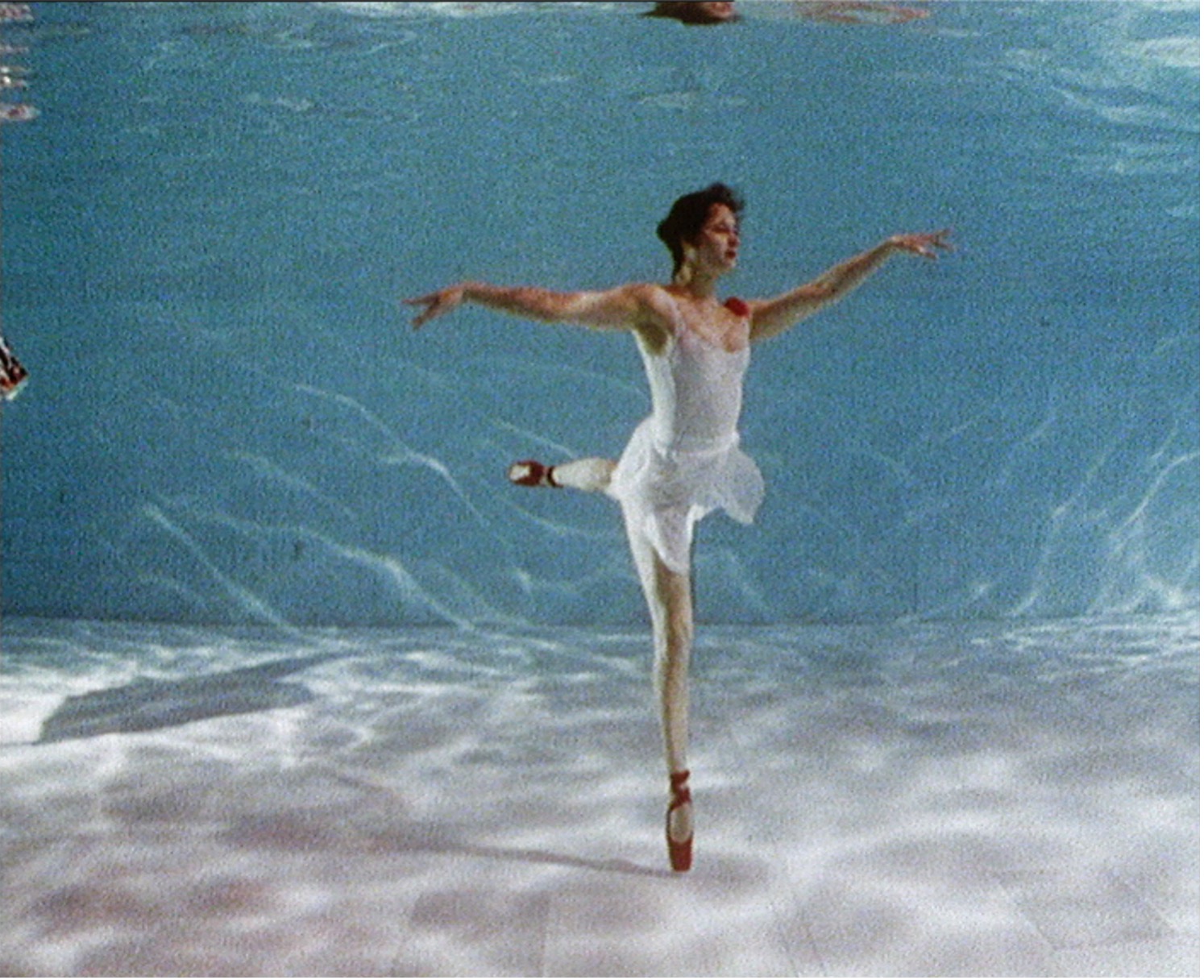
Still from Jayne Parker, Debbi Figueiredo performing underwater in The Whirlpool (1997).
Copyright Jayne Parker. Courtesy of the artist and LUX, London.
Jayne Parker:
Perhaps that’s the reason.
When I worked with a cinematographer higher-end professional film cameras and
lenses were used, which accounts for the finer grain of the films.
Nina Danino:
Crystal Aquarium the camera is positioned around the performance on
low shots, overhead shots, the body of the performer and the camera are always
in a relationship to each other. There is a sequence of low-level shots of the
skater’s skates gliding on the ice – how did you get that shot? Also the hands
of the pianist Katharina Wolpe are so precisely framed for the sequence of
music she is playing in The Whirlpool.
The framing and the performance and cinematography all fit perfectly.
Jayne Parker:
The close-up shots of the
skates were shot away from the ice rink, on a block of ice mounted on a
scaffold, or else I wouldn’t have been able to film as I wanted to. With the
framing of the pianist’s hands, I always worked out where they would be, either
in the air or on various sections of the piano keyboard, and framed
accordingly. The majority of shots are premeditated but there is always space
for the unexpected or if something doesn’t work on the day. It's to do with the
image; it's to do with realising the image. I think if I see something that I
want to film, like you mentioned earlier, there is an urgency, I've just got to
do it.
Nina Danino:
The drive to make a film is
necessary as it’s often the main reason to make it. There are so many hurdles
to overcome so there has to be an urgency to realising it.
Jayne Parker:
Yes. Then that fear – am I
going to be able to capture it? Will I be able to capture it? When you begin
something new, everything is possible. Knowledge and habit don’t get in the
way, and there isn’t the same fear of failure. It's this striving to get something
right – for me it's either right or wrong, there isn't any middle ground, or it
can be the best that I can do.
Nina Danino:
Particularly when you're trying to make a film communicate about experiences that are oblique in some way. To quote Al [Rees] again ‘on the borderline of naming’.[17] Not in a direct way, but that sense of – what word did you use?
Jayne Parker:
The capture.
Nina Danino:
Capturing. Because capturing
is something that isn't just about the images. It’s also about how the film
experience imparts that ‘intensity’.
Jayne Parker:
For some things I've never
been able to capture the quality I wanted. It is interesting that we are drawn
to one take rather than another. When I am editing, I’m asking: ‘What's going
to carry the tension? What's going to carry meaning?’ Some shots can be
beautiful, really lovely and technically fine and all that, but there is
something missing. A lot of footage that I shoot is discarded – maybe because I
am not following a storyboard. I have a shooting script but that's different.
Nina Danino:
The shooting script is the
order of the shots.
Jayne Parker:
Yes, and a set of drawn
images indicating each shot I want to take, such as a wide shot, mid-shot,
close-up, taken from this angle or that angle, and from this point in the
action.
Nina Danino:
Your films look very highly
executed like they have been highly prepared and planned.
Jayne Parker:
I have a drawn shot list –
but not ordered into an imagined completed film. When working with a
cinematographer I draw directions for each shot, because I want the image
framed in a particular way. I learnt the hard way by saying “I want this – but
do what you think”, by not being assertive and clear – I've really learnt on
the job to trust what I want. It was quite hard to learn that, particularly in
the industry, when funding came with different working demands.
Nina Danino:
The films that you made in
the nineties, The Whirlpool (1997), Crystal Aquarium (1995), Cold Jazz (1993) were all produced with
funding from television.
Jayne Parker:
Yes, the first was The Pool (1991), a commission for
Channel 4’s Eleventh Hour experimental slot, funded by the Arts Council. It
came with the proviso that you worked with a production company and a small
crew.
Nina Danino:
How did you find that
experience after having made your work yourself?
Jayne Parker:
Difficult but also very
valuable. I worked with the cinematographer Patrick Duval and that worked very
well. He took great care filming. I worked on several films with the
cinematographer Belinda Parsons. She's very sensitive as a cinematographer, and
we had a very good relationship, we worked well together. I think one of the
problems for me is that it made me lose confidence about using the camera for a
while. I could decide what was going in the shots, set the frame, and then
somebody else would check the exposure and press the button. I felt it more
keenly with the music films. Belinda filmed several of them but with the later
ones I returned to filming myself. That gave me back something that I felt I'd
lost - a connection with the moment of filming.
Nina Danino:
I agree, Sarah Pucill, Anna Thew and Barbara Meter have also
spoken about the importance or difference of filming and of looking through the
camera oneself.
Jayne Parker:
I think for all of us, there
is the effect of funding, often you can see it in the resulting film –
commissions can take you on a certain route. It can affect the look of the
film. Funding opens up the possibility to do things you couldn’t do on your own
but it comes with its own demands and production values, which is something
that I always wanted to resist.
Nina Danino:
Commissioning editors from
television and from the BFI had editorial control whereas the Arts Council
Artists’ Film and Video was more artist-centred funding. Maya Deren does warn
‘against the complications that would arise from an effort to emulate the industry’.[18]
I had to make a shorter version of “Now I
am yours” (1992) which was funded by Channel 4 because of broadcast time
slots.
Jayne Parker:
During that period I learnt
that funding is amazing because it allows you to do things that you might not
be able to achieve on your own, but it doesn't give you any more time. For
instance, for Crystal Aquarium, we
were able to film in Channel 4's studio and construct a scaffold to hold a
block of ice. It was an amazing stage setting that would have been impossible
to do on my own and yet we still had to be out by what, five or six o'clock.
You have this extraordinary set, but you have even less time than if you had
set it up in your front room or somewhere.
It's just a different way of
thinking and working. If I didn't know what to do at that moment, I had to
learn to take myself away and think about it and not transfer my own anxiety
onto other people because they didn't know what I wanted. They were just doing
their job, waiting for me to direct. But I should say that I don’t think I ever
feel out of control during filmmaking, as the outcome is my responsibility.
Nina Danino:
All your films still come
across as very controlled, precise and very highly crafted. Could you talk
about how you achieved this?
Jayne Parker:
I worked as an assistant
film editor, which was very useful and good training – in fact you got me that
job at the BBC when it had its own in-house training for directors.
Nina Danino:
There were a few of us from
the LFMC there. It could be frustrating if you wanted to be an experimental
filmmaker. I worked mainly on documentaries for the BBC and independent films.
I was totally committed to a path in experimental film and felt very conflicted
about those two sides but now I am glad I went through that training and
professional experience.
Jayne Parker:
Directors and producers were
making short training films and we assisted the editors. I didn't know how to
sync rushes when I went in on the first day. I remember Marek Budinsky showing
me how to do it. I feel very grateful for that insight into the industry.
Nina Danino:
Nicky Hamlyn, Marek Budinsky
were other artists at the BBC from the London Film-makers’ Co-op [LFMC]. I was
fascinated to see how there are ways to shoot different kinds of films. The
Directors’ Training Programme which I worked on also did music and dance films
and short dramas.
Jayne Parker:
I liked the role, I liked
learning from them. I always like to be behind the scenes, being in the wings
of the theatre or being in the rehearsal room or being in the edit room,
they're the places of making.
Nina Danino:
It was interesting because
it showed the method. I'm fascinated by method. To learn how to organise a
cutting room or how to shoot for music or dance or point of view in drama.
Jayne Parker:
Yes, and a way to do it. You
know, even if it's small things like using a red pen to mark up the tins
containing sound, and a blue pen for those containing the image. That way you
can see at a glance what material is in the tin.
Nina Danino:
Yes, in documentaries where
there were often many hours of footage, it was imperative not to start editing
the ‘rushes’ – the footage developed by the labs – till you were properly set
up which meant having transcripts for the interviews and all the footage
logged. All these methods placed an order on the material. It was gruelling to
do. I never so much as cut one single frame of my films without logging
everything meticulously. This means that I can find everything on paper from a
description of that shot without having to search for it, to look for it
physically. No editing that I have done would be possible without the training
I did. Even a film such as Stabat Mater
or “Now I am yours” that are very
experimental and seem freely put together, every shot is logged and the whole
film constructed on paper.
Jayne Parker:
I also log every shot – it’s
necessary to keep track of the footage and know the limit of your negative. It
is also a way to get to know the material, to see its potential and let go of
pre-formed ideas or disappointment. It was very useful learning about editing
and filmmaking procedures. When I edit my films I am using an established
editing language.
Nina Danino:
Can you talk about using
this language in your films. You don't use the cutaway. This shot was the
standard method with which you could bridge jumps in the continuity of eye line
in drama or cover the jumps in an interview in sections of a documentary. This
jump is often smoothed over or left exposed today because the cutaway looks too
contrived. But these were professional techniques designed to hide the edits.
Also, it is somewhat violent to jump cut between shots of the person being
filmed, which is why it is often used as jolts in experimental film. Do you use
establishing shots which are a wide shot of the scene?
Jayne Parker:
I sometimes use establishing
shots but more often I shoot them and don't use them. I'm often filming
parallel actions and inter-cutting back and forth, so continuity continues
between shots as well as in the action itself.
Nina Danino:
You do use it in the
continuity form?
Jayne Parker:
Yes. I follow it, I'm using
the language.
Nina Danino:
But you're also disrupting
the language. Because you're not using all of the grammar, you're only using
some of the grammar. Could you talk about your use of the grammar.
Jayne Parker:
Yes. I remember someone
saying to me, it's usual to put the close up after the wide shot and I'd done
it the opposite way round. I didn’t like being told how to do, because the edit
was the way I wanted it to be.
Nina Danino:
Yes, I was taught that you
put the wide shot or establishing shot first and then the others. I worked
often with a very good editor called Colin Hobson. He would make changes on the
fly on the Steenbeck if we had the commissioning editors or the director in the
cutting room and they wanted to see an alternative cut and he did it in a
flash. I don’t like the point of view system and especially filming the over
the shoulder shot. I do like continuity as it is a way of giving a space to the
subjects filmed.
Jayne Parker:
For a long time, in my
films, there were never two people in a frame. Scenes were shot separately and
people brought together through the edit. I didn't have that crossing the line
problem when filming, although I might encounter it later when editing. Everything
is implied.
Nina Danino:
Can you talk about the music
films Thinking Twice (1997), the Foxfire Eins series (2000), Stationary Music (2005), Catalogue of Birds: Book 3 (2006), and Trilogy – Kettles Yard (2008)? They are pristine and shot immaculately in
terms of continuity and music.
Jayne Parker:
With those films, I have to
follow the linearity of the music. I am locked into it.
Nina Danino:
Do the performers play the
piece multiple times and you shoot it from different angles?
Jayne Parker:
Yes. For all the music films
I prepared detailed shooting plans, working out in advance the framing of each
shot and where in the music it began and ended. I would also film a master
shot, sometimes two, of the complete composition. Repeatedly playing some of
these pieces could be very tiring and I tried to minimise the number of times
the musician had to play. I only ever used one camera.
Nina Danino:
These are live and very intense performances. Do you take up a role as a director regarding the performance and also directing the performer musician?[19]
Jayne Parker:
I think with those films,
with filming people generally and with the musicians, I never want to take away
from the integrity of the performance, if it's ice skating or swimming or
musical performance. I wouldn’t tell them how to perform but it would be clear
in advance what they were going to do.
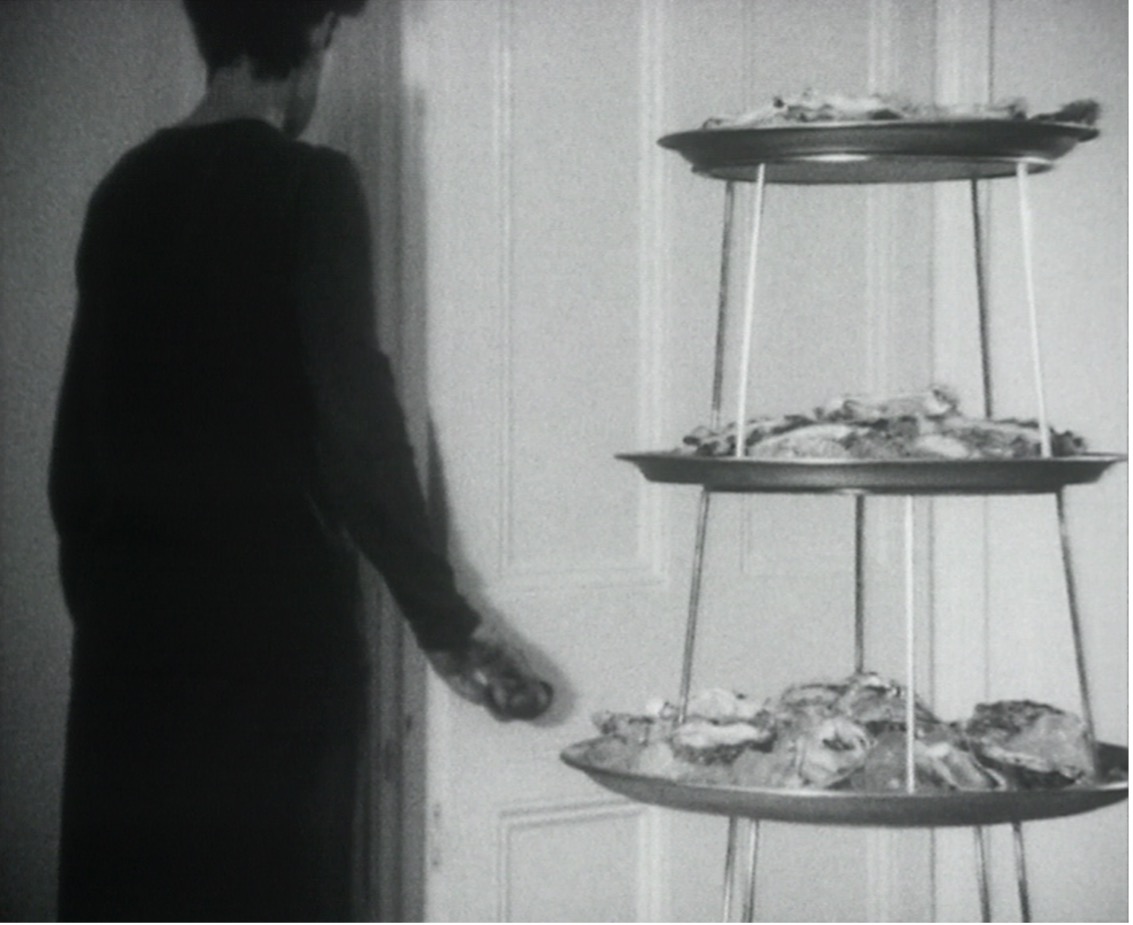
Still from Jayne Parker, Natalia Gorbenko in Crystal Aquarium (1995).
Copyright Jayne Parker. Courtesy of the artist and LUX, London.
Nina Danino:
Crystal Aquarium is also so precisely shot.
It has four performers: a drummer, a swimmer, an ice-skater and you.[20]
This film was awarded the Grand Prize and other accolades at Oberhausen in
1997. The music films have the same quality of precision, economy and
intensity. You never forget that there is a camera and framing and editing, but
the performer is able to perform. How do you combine the two?
Jayne Parker:
I always want to leave space
for them to be the musician or the performer. As I mentioned earlier with the
music films I follow the linearity of the music, its continuity. Some sections
of other films are shot with continuity in mind too, for instance the first
part of K. as I wanted to follow the
action through to the completion of the knitting. I think there is a different
approach when I’m not filming a musician or continuous action.
Nina Danino:
Could you say in what way is
it different?
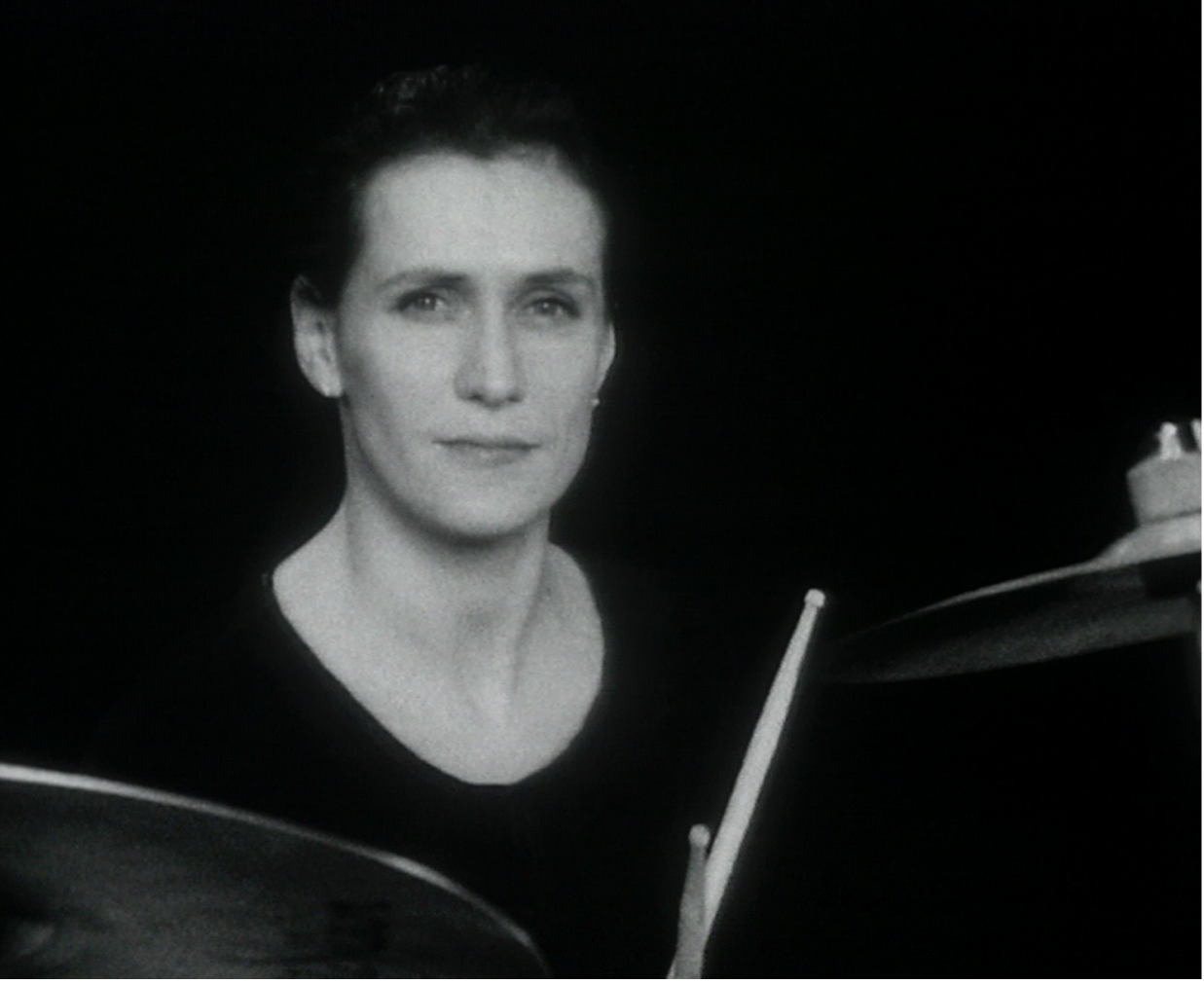
Still of Michelle Drees in
Jayne Parker, Crystal Aquarium
(1995).
Copyright Jayne Parker.
Courtesy of the artist and LUX, London.
Jayne Parker:
Maybe it is slightly different in that the pace of the film is
determined by the editing and not driven by the tempo of the music. In the
diving section of K. I cut in-between
the action when the frame is cleared. I cut when there's nobody in the frame,
before I enter the frame and after I leave the frame – shots aren’t intercut.
This was a conscious decision. I've always liked the work of filmmaker Yasujirō
Ozu and it is a technique he uses. For example, if Ozu is filming a
conversation, we see an image of the first person, they speak, he then cuts to
the second person and they answer, then he cuts back to the view of the first
person, they speak and so on. The dialogue isn’t overlaid while someone reacts
to it. Also, I like his placement of the camera at the level of whatever he is
filming – I like to be in front of the subject I’m filming.
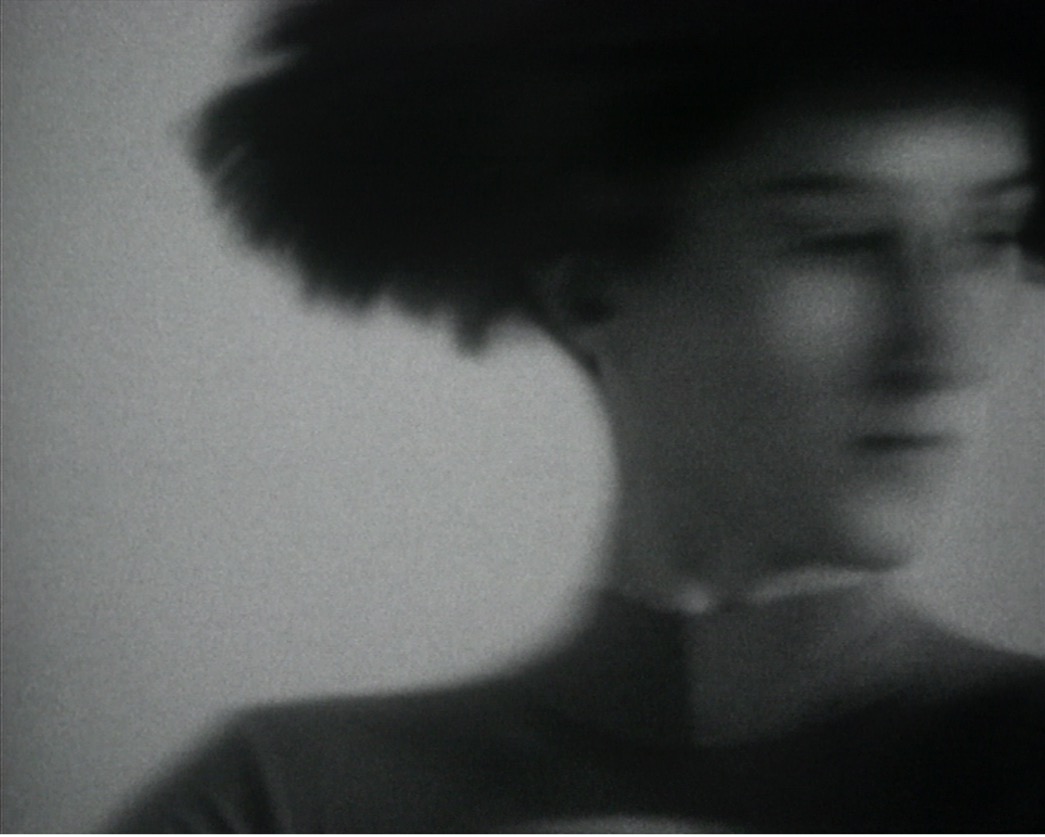
Still of Natalia Gorbenko in
Jayne Parker, Crystal Aquarium
(1995).
Copyright Jayne Parker.
Courtesy of the artist and LUX, London.
Nina Danino:
The formal decisions and
spatial continuity also allow space for the performer which I like to give as I
mentioned earlier.
Jayne Parker:
Yes, I am very interested in
space, and I’m particularly interested in touch – and the action of touch, for
instance, the feel of the cold eel held next to the skin in The Pool, feeling the underside of the
ice in Crystal Aquarium, the act of
the musician playing a musical instrument, which determines the expression of
music. I think there is something absolute about material knowing through
sensation, through the hand. Also, with the music films, particularly because
music in itself has no obvious visible material quality, other than vibration
and the site of playing, you can film anywhere in the room and the sound would
be continuous in that space.
Nina Danino:
Does structural film inform
the formal precision, especially in the music films?
Jayne Parker:
I’m not sure it does in a
direct or conscious way. I definitely like a locked-off camera, the image
framed so the action happens in front of it. When I made Cold Jazz (1993), I realised I'd become so formal there was nowhere
to go, and that was difficult. This difficulty crossed over with the subject
matter of the film too. In that film there is no transformation, and the desire
for transformation is something that drives all of the early films. I felt
really stuck, nothing happens in the film, it's just consuming in the hope that
something will happen. In the film I open and eat a lot of oysters. I don’t
enjoy eating oysters – there is no pleasure. When you open an oyster you
destroy it. It's probably the most violent of all those films, because there's
a real death. For me, it is an image of consuming the most wanted thing, and
the act of consuming destroys it.
Nina Danino:
Was it the formalism or the
symbolism in Cold Jazz, the oysters,
and in Crystal Aquarium, fire, that
became something dead to you?
Jayne Parker:
The images are highly active
but their meaning within the film is one of arrest. With Cold Jazz it was the formalism within my approach that felt like
entrapment but then this was the subject matter of the film. There was no space
for spontaneity. I didn’t feel like this when I was making Crystal Aquarium.
Nina Danino:
You are the protagonist.
Jayne Parker:
Yes, I'm in both Cold Jazz and Crystal Aquarium, which I feel marked the end of me taking a
protagonist’s role in my films, although I appear briefly in Blues in B-flat (part of Foxfire Eins) (2000) and The Oblique (2018).
Nina Danino:
From 2000 onwards, you are
not so present in the work as a performer then? Did you begin to use other
performers again? Why did you decide to minimise your presence?
Jayne Parker:
First of all, I think of my
films as a form of documentation of performance on film. There is a strong
documenting aspect to how I film things. I’m directing the viewer to what I
want them to see through the editing, but also in the way the shots are framed,
and where the feeling is in what I'm filming. With Crystal Aquarium I felt I reached the end of what I could actually
embody as a performer. I'm not an actress, and that was my limit.
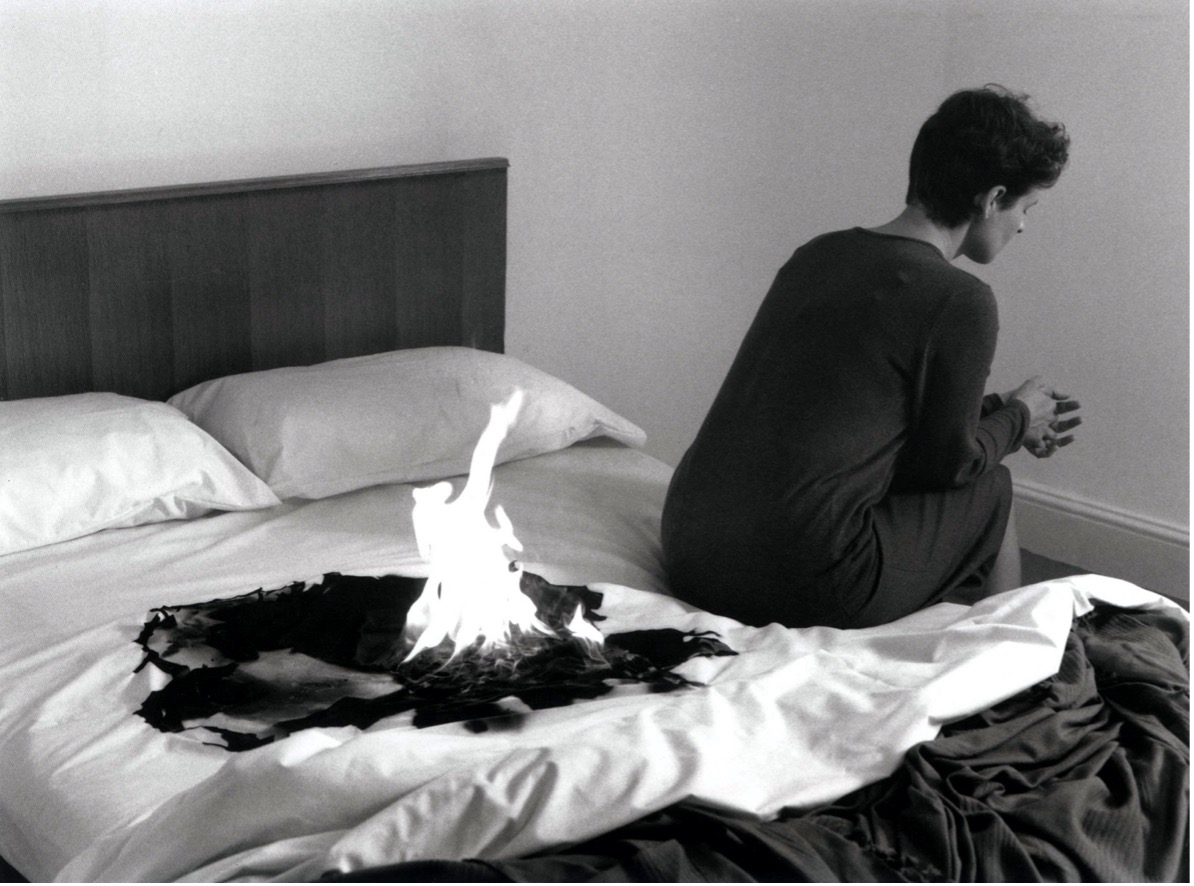
Production still from Jayne
Parker, Crystal Aquarium (1995).
Copyright Jayne Parker.
Courtesy of the artist and LUX, London.
Nina Danino:
I wonder also whether,
because these are intense practices and you are at the centre of the work,
whether you wanted to be free of that role of protagonist and of being the
subject – under the camera lens and the gaze?
Jayne Parker:
I wanted to make work that
was less introspective, and the move to placing the musician as the focus
offered a way out of that. I felt I was repeating myself. But in the end, even
with the music films, there's the same subject, there's the body in relation to
object, object as body, inside, outside. Maybe it's not as obvious, but it's
exactly the same scenario really as in the other films.
Nina Danino:
Can you talk about making
these films and introspection?
Jayne Parker:
It was certainly a way of
looking at and confronting things that I found difficult. I've always made a
big distinction between my work and my life. What’s on the screen is not an
analysis of me. I move on, I change, I might think something different tomorrow.
Although it's a bit of a contradiction as I can't really separate out life and
making, as I’m filming things that resonate with me. I think of myself as a
gleaner, looking for images that carry or resonate in a particular way. I used
to think of the early films as beacons or holding structures, and when I saw
them they would reactivate what I felt, but contain it too.
Nina Danino:
Do you think that you were able to realise or confront yourself to some extent through the making of the films? Through a particular visual language of filmmaking?[21]
Jayne Parker:
It's a form of expression.
It's certainly a way of looking at and exploring things – trying to see things
as they are. I've always felt that the filmic space was completely free, and
even though my life might be moderated or moulded by society, or a situation,
or personal traits, no-one can tell me what to do on the screen. It is a
completely free space.
Nina Danino:
Are they a confrontation
with /of the self. Did you make them primarily for yourself?
Jayne Parker:
I made them out of a
compulsion to make them, and that drive that we talked about earlier, and
because it was a way of structuring, understanding and reflecting on the way I
see the world, the agency of the body, relationships, longing, restriction,
resistance, and so on. It is a way of ordering things.
Nina Danino:
Yes I see them as
confrontations with the/a self through visual language. Experimental film is
thought of as a free self-expressive form but at the same time we've been
describing it as a highly structured form. As a form of expression, it gives a
framework around which you can make a film which is not a limitation but a
structure. So, it's not just about unconsidered expression, it's a rigorous
visual language.
Jayne Parker:
Yes and also the
understanding of material – of 16mm film material. Just thinking of it purely
materially, for instance, the way you have to plan if you want to have
something superimposed or you want a dissolve – although I've never been able
to find a reason to do either of those two things, despite trying. The material
will only allow you to do certain things. If you haven't got the negative, you
haven't got the negative. I really like that necessary rigour.
Nina Danino:
It was so important that the
chosen visual techniques were intrinsic to what you are trying to say rather
than as a special effect or something which you could lay on top without having
a reason.
Jayne Parker:
Yes, it's the same with the
optical printer which allows you to reframe and repeat an image or repeat
frames in order to slow down the motion, or still the image. I love that
machine but then I think why would I reframe something? I should have framed it
like that in the first place. Why would I step print something? I should have
filmed it like that. This is my own inner voice, which won't allow me to alter
those things that I should have thought about at the shooting stage. I can see
other people do it and I like it, but I can’t do it myself.
Nina Danino:
The framing is so important
in your films.
Jayne Parker:
Yes. I like film’s
precision, that it can only be this frame. I always found that very difficult
when video first came in, that there were more possibilities with the material,
that there could be multiple edits and endings – for me there weren’t. There was
only the one I chose.
Nina Danino:
With video you can copy over
multiple times, whereas experimental film emphasised the present of making, the
means, the medium, the material – perhaps the photographic original. The
mechanics of film; camera, printers, editing machines, the engagement with the
means of production came from a structural approach but your films add the
symbolist and dramatic language. As well as Pierre Attala, your mentor at
Canterbury, were other teachers, thinkers, theorists important?
Jayne Parker:
There were teachers I had at
art school that were very valuable to me. On foundation in Mansfield Trevor
Ellis was a great supporter and early influence as was the artist Brian Catling
at Canterbury, who told me that I was dying in painting and got me to move to
sculpture. Chris Welsby and Lis Rhodes at the Slade were important figures and
introduced me to the world of experimental and avant-garde film in London.
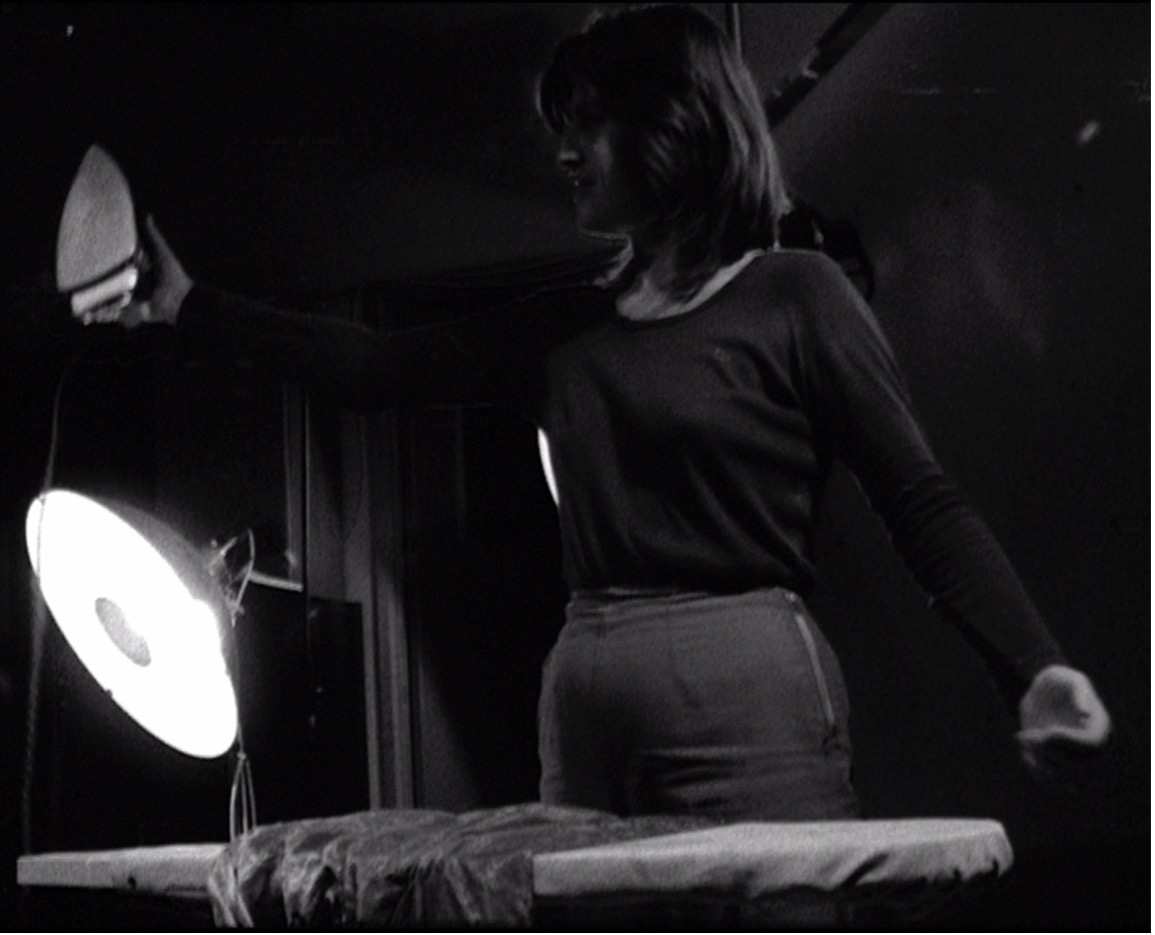
Still of Claire Winter in
Jayne Parker, Freeshow (1979).
Copyright Jayne Parker.
Courtesy of the artist and LUX, London.
A.L. Rees was an important
figure and a good friend. If I showed a finished film to Al, he would never say
very much, but he would indicate his reaction with a characteristic nod and a
pause. I always thought ‘if Al likes it, it's all right’. Yes, he was a very
important figure. The critic Michael O’Pray too, and the journalist-critic Jill
McGreal. I would like to mention Maya Vision and in particular Christopher
Collins, who over-saw the production of many of the funded films.
Nina Danino:
What about the feminist
debates, did you engage with those at the time?
Jayne Parker:
I've always considered
myself a feminist. When I was young, I was particularly aware of women's work
and feminist debates. I never wanted anyone to tell me what to do. I think I
thought that I could avoid being subjected to patriarchy!
Nina Danino:
Did you engage with feminism
as a context for your films?
Jayne Parker:
Yes but in an oblique way.
In a film like Free Show (1979), it
is more direct. Free Show looks at
where violence starts, and it can be in the domestic, in the smallest action in
the home or in personal bodily attention such as the violence of plucking
eyebrows.
Nina Danino:
Yes, the films could be read
from a feminist perspective. Certain acts refer to domestic chores which seem
to be performed against their purpose as an act of resistance, like the ironing
in Freeshow, which is burning a hole.
The protagonists are female and play out restrictive social conditions, the
re-staging of domestic chores is performed in a restrained way: the cutting,
the chopping, the recipes, highlighting the violent gestures.
Jayne Parker:
That film, through its title
‘Free Show’, references performing
without the giving of oneself, as a form of resistance. Everything is done with
a sense of withholding, and maybe resentment.
Nina Danino:
The obsessive plucking of
eyebrows is painful to watch because in big close up it shows the pull of the
skin. The sheets in Snig are hung to
dry in the normal way but when spread out are full of nightmares emblemised by
eels squirming and then the dead eels which are shaken out.
Nina Danino:
I Dish, which is a signature narrative experimental film of yours I feel,
stages the gestures of the two protagonists, a man and a woman, who are never
seen together but perform different ritualistic activities in what’s implied as
the same space. The woman is seen in a somnambulist-like act of solitary
eating. Then the man is seen washing himself also alone – the images are
unexpected and dissonant. The lack of sound further isolates the protagonists
from each other in the domestic space.
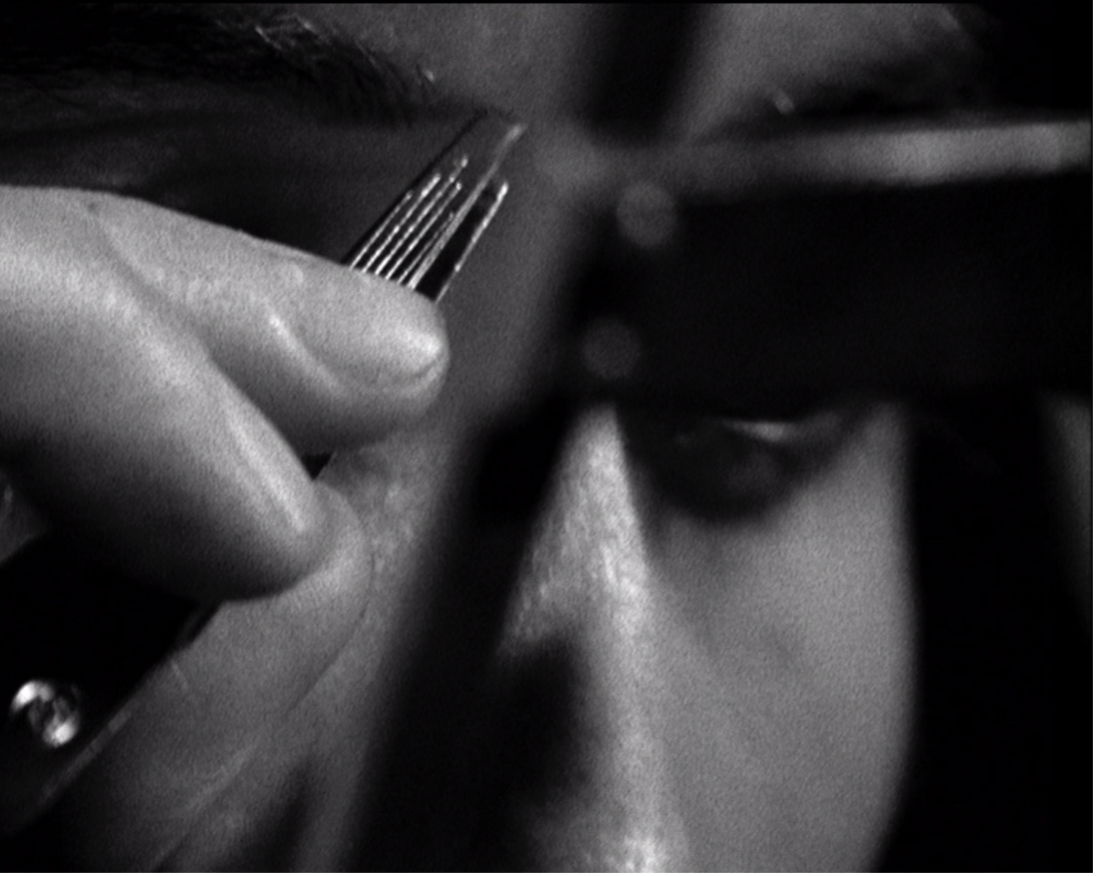
Still of Claire Winter in
Jayne Parker, Freeshow (1979).
Copyright Jayne Parker.
Courtesy of the artist and LUX, London.
Jayne Parker:
I had this idea that men
could wash and be cleansed but women couldn’t be cleansed in the same way.
Nina Danino:
The films are less read or
written about from that perspective. Yet they are feminist in the sense of
depicting female protagonists’ resistance and gesture.
Jayne Parker:
It’s interesting. When the
films were first distributed I went to Circles,
which was a women’s film and video distribution organisation. I felt at the
time it was a way of having control over how my work was seen. It was good to
be part of Circles.
There was a lot of work
being made by women about women and health, social issues and agendas, and I
began to see that as soon as you put one of my films alongside these films it
was out of place. Also, I made Snig
and they didn't want to distribute it over concerns that it was too violent,
and although I understood the reasons for their decision, I felt silenced. At
least this is how I remember it. It was probably 1982 or 1983, and there was a
lot of discussion about how women should film women, how you mustn't fragment
the body, and awareness of how images and signifiers could be read as
patriarchal, for instance filming a women behind a desk may be seen as a
patriarchal symbol. It came out of a need to challenge accepted ways of filming
that perpetuated patriarchal view points and values. Women were challenging and
changing the way they were portrayed and their place in the industry. But, in
my youth, I felt I didn't want women to tell me how to do something – I never
want anyone to tell me what to do.
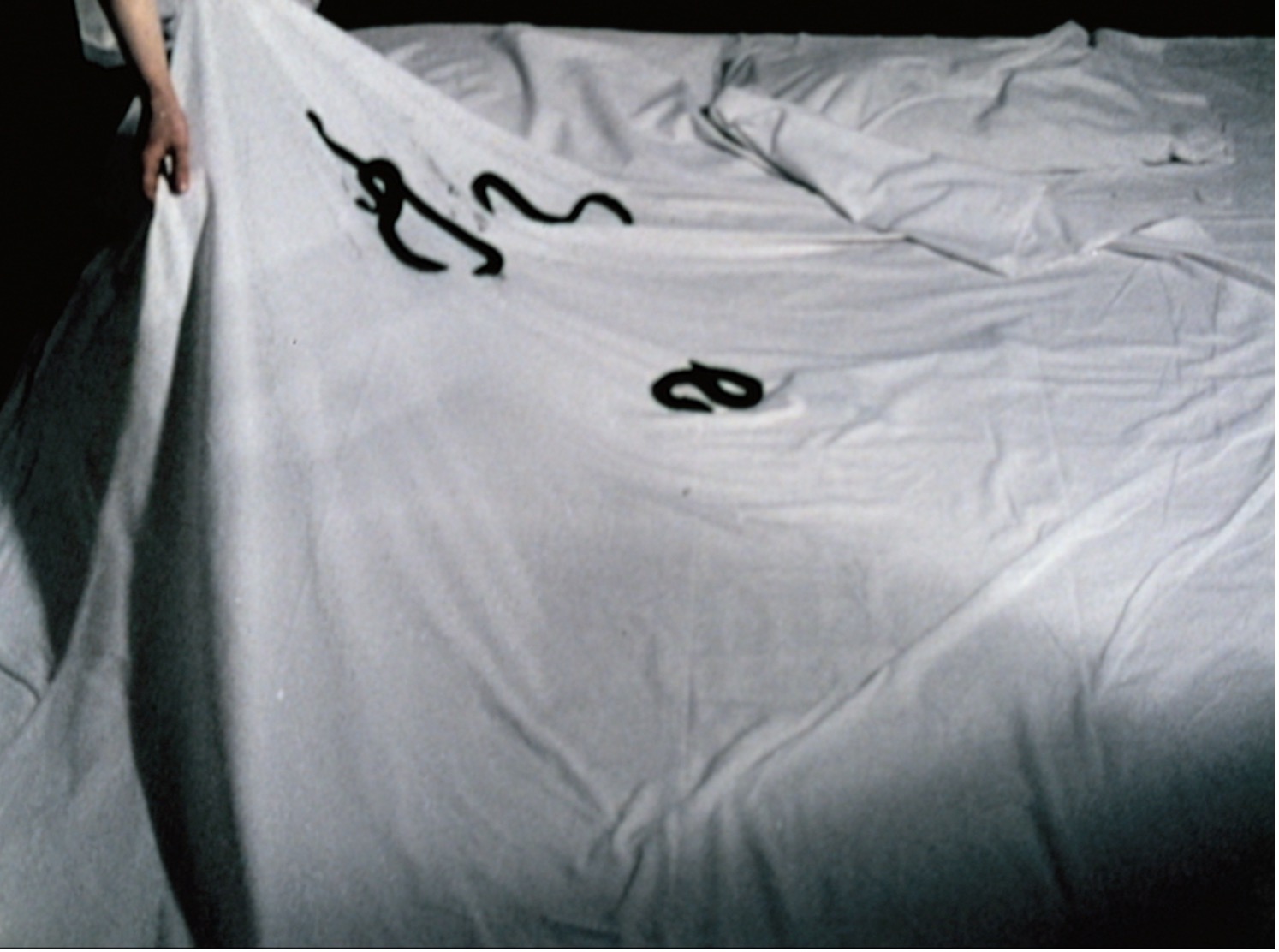
Still from Jayne Parker, Snig (1982).
Copyright Jayne Parker.
Courtesy of the artist and LUX, London.
Nina Danino:
There were a lot of rules
and messages.
Jayne Parker:
Yes, there was Cinema of Women, Circles and the LFMC. I had a great respect for the people in all
of these different organisations and for what they were working to achieve. Film can be such a useful tool for
raising social issues and consciousness. I moved to the LFMC when I felt out of
place, when I felt I wasn’t
addressing things in a way that fully reflected the values of Circles.
Nina Danino:
Circles distributed historical and feminist films by woman. Cinema of Women had a more social,
political activist, educational and social agenda and the London Film-makers’
Co-op centred on artists’ filmmaking. There was a perceived choice as to where
you distributed your films as Sarah Pucill also talks about in our conversation.
Jayne Parker:
It is interesting to
remember the times and reflect on the history and the endeavour to take
control.
Nina Danino:
What was your experience
when moving image started to shift into the gallery in the nineties? Did it
shift your artistic identity also? In the eighties and nineties, we called
ourselves filmmakers, I don’t recall anyone being called an artist filmmaker. Being
an artist was a given but no one used the term artist. Expanded cinema was part
of experimental film it was not called installation then but I don’t recall
galleries showing film before the mid-nineties. I may be wrong. In the eighties
if you were an experimental filmmaker it was in the context of a cinema-culture
in which you showed in programmes, festivals, film tours and cinema screenings.
Jayne Parker:
It was an interesting time.
I always felt divided as an artist and a filmmaker. My films didn’t naturally
find a way into the gallery. There were some artists or filmmakers,
video-makers, who made the transition into the gallery. But I don't think I've
ever been seen as a gallery artist.
Nina Danino:
Did you want to be?
Jayne Parker:
In some ways yes – I wanted
my work to be seen – and maybe more now, but in other ways I found it
problematic seeing films within the gallery context, and still do. When you can
come in to the film at any point it makes a nonsense of the decisions you make
when editing, when you don't want to reveal what's happening until later in the
film. Creating meaning in film through editing is cumulative, what we see, what
we think we see, and the pacing of it directs the meaning.
Nina Danino:
Do you want to show your
work mainly in galleries now?
Jayne Parker:
I’m mainly showing in film
festivals and film screenings but I am very happy to show in a gallery if
anyone asks me. But I think it's changed something. I used to love going to
film screenings and afterwards thinking about what I saw. What did I see? Did I
see that? How you remember or mis-remember things, how sometimes you can see
someone's work and elide two films together, and then when you see it again you
think, I can't remember it being like that. It's like a new experience each
time. In a gallery a looped work is playing all the time, and I think we’re not
prepared to engage with duration in the same way, at least I don’t find it easy
to settle into the pace of extended moving image work in a gallery.
Nina Danino:
Yes giving the time to the
screening and one’s full attention till the end of the film.
Jayne Parker:
Yes and to actually give
oneself to that work. One wonderful screening I attended in the 1980s – I don't
remember where – was of US filmmaker Kenneth Anger’s Inauguration of the Pleasure Dome (1954). It was projected in a
pitch black theatre, screened in darkness. It was so rich. The experience has
stayed with me all these years.
Nina Danino:
In the gallery, sound is
difficult to control. Also, as a viewer it is grey light and you are aware of
the other people around you.
Jayne Parker:
It's almost like you're one
removed from it, rather than being lost in the space of the film. The black
isn’t black, now almost everything is digitalised. In a cinema setting it's an
experience, a collective experience. It's one of the things that made me – and
this is more in relation to performance art really […] – turn towards experimental music. I found in
experimental music the live experience, when a lot of performance work had
become mediated through video. There's something about being present in the
moment of projection or performance that I value. That is where the experience
is – in the moment.
Nina Danino:
Yet you said you want to
engage more sculpturally with the physical space. And you're making sculptural
pieces using magnolia wood and stone carving? You were also talking about
expanding out from the intensity of linear experimental film.
I still want intensity and I still want to make films – that
hasn’t changed. When I was a student at the Slade, I was in an area called
Experimental Media, and we were based in what is now called the North West
Wing, in white cubical spaces. I hadn't realised how important being in a
sculptural environment had been for me as an undergraduate student, and I
missed the materiality around me. I think from that moment on, object making
seemed to fall away, and filmmaking drew everything in. I was never able to mine
the strata of my ideas, or make different variations through other means,
either in photography or through object making. Now I can see how I could have
done that, and how I can do that now. A turning point was the work commissioned
by Spacex Gallery and Film and Video Umbrella, a series of films with Anton
Lukoszevieze, called Foxfire Eins (2000).
They were commissioned for and installed in gallery settings. It made me
realise that I could make work that could occupy space. It’s the same with
making objects. It's about extending out into the material world.
Nina Danino:
Which perhaps is a
reconnection with your sculptural formation.
Jayne Parker:
To the physical world, yes.
Nina Danino:
As well as showing the film The Oblique in the exhibition Still Life together with photographs at
A.P.T. Gallery (London) which we mentioned at the start of this conversation
you are also showing hand sized stone sculptures and branches.
Jayne Parker:
Yes – it was a joint
exhibition with painter Lisa Milroy. That was a big thing for me because it was
the first time I'd shown predominantly sculptural works and photographs, as
well as film, in a very long time.
Nina Danino:
So it is a new phase of
making?
Jayne Parker:
Yes.
Nina Danino:
Would you like to make any
concluding remarks or is there anything that you would like to comment on from
this conversation before ending?
Jayne Parker:
Only that I really value
this chance to speak with you in such detail. Our conversation feels like a
receptacle for common ground, shared history, experience, materiality and
process. I’ve thought about things I haven’t thought about for a long time. Thank
you.
Nina Danino:
Thank you too.
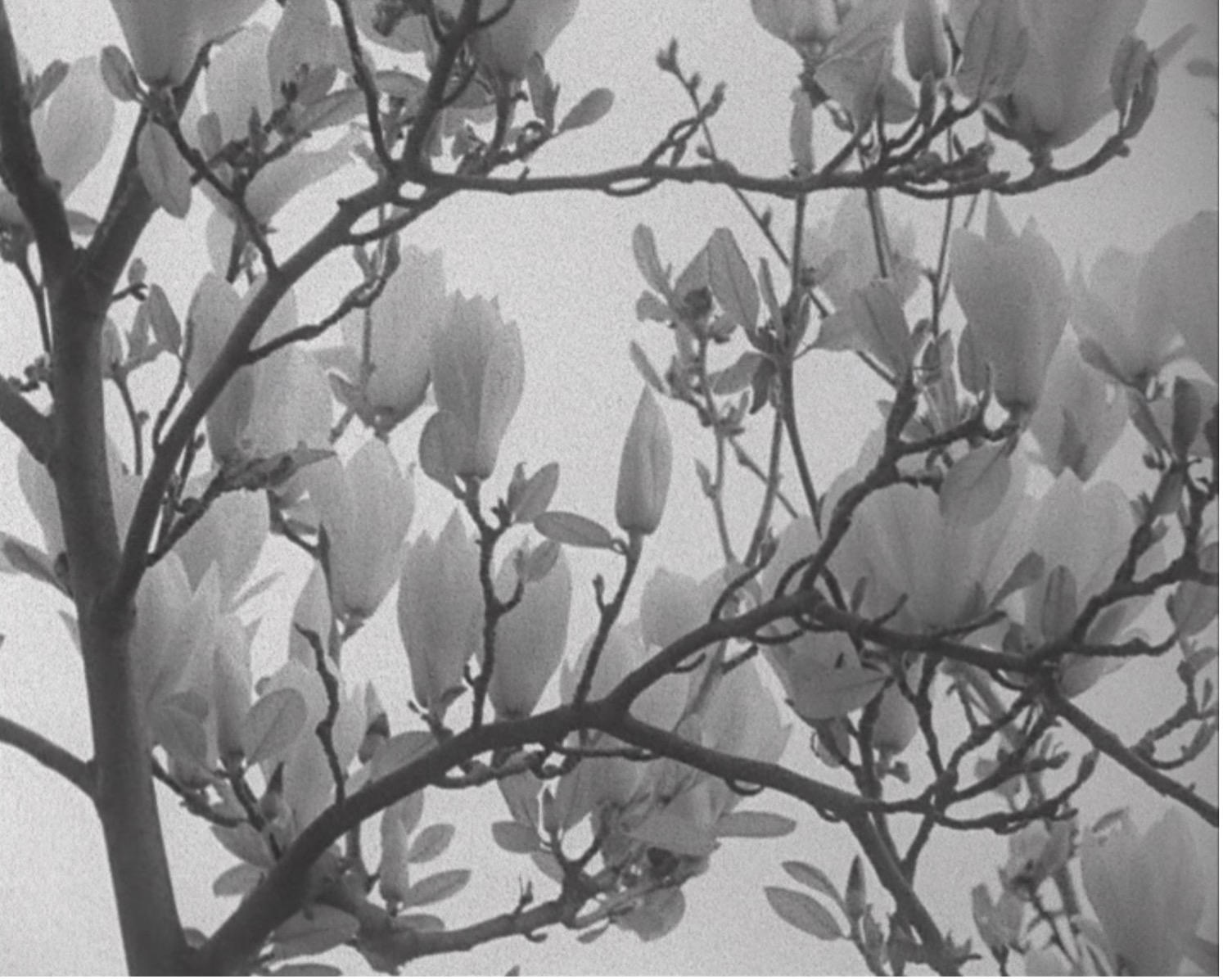
Still from Jayne Parker, Stationary Music (2005).
Copyright Jayne Parker.
Courtesy of the artist and LUX, London.
_____________________________________________________
Biographies
Jayne Parker was born
in Nottingham in 1957. She completed her foundation at Mansfield College of Art
(1977) before studying sculpture at Canterbury College of Art (1977–80) and
Experimental Media at the Slade School of Fine Art, University College London
(1980–82). In her films objects, performance and gesture are brought together
to explore space, expression and the physical body. In 2008 a DVD compilation
of her films was released by the British Film Institute in their British
Artists' Film series. She participated in From
Reel to Real: Women, Feminism and the London Film-makers’ Co-operative (2016),
a series of screenings and discussions at Tate Modern celebrating the 50th
anniversary of the London Film-Makers' Co-operative. She was a part-time
lecturer at Goldsmiths College from 1984 until 1998 and has taught at the Slade
School of Fine Art since 1989 where she is currently a Professor of Fine Art.
Her films are distributed by LUX.
Nina Danino was born in Gibraltar. She is a Reader in Fine Art at Goldsmiths, University of London. She studied Painting at St. Martin’s School of Art and Environmental Media at the Royal College of Art, London. She was a member of the London Film Makers’ Co-operative in the 1980s, a member of the editorial collective of Undercut: The Journal of the London Film-makers’ Co-operative (1981-1990) and co-editor of The Undercut Reader (Columbia University Press, 2003). Her films have been shown worldwide and premiered at film festivals and broadcast on television and a retrospective of her work took place at Close Up Cinema, London in 2016. MARIA (2023) is her fifth feature-length film. Her soundtracks feature vocals, singing, readings, narration and music in her own voice and in collaboration with singers and musicians. Her recent work crosses into stand-alone audio, live performance and studio recording.
_____________________________________________________
Select Bibliography
Danino, N., Mackay, J., Mazière, M.,
Smith, V. and Fowler, W. 2014. Roundtable Discussion: London Film-Makers’ Co-Op
– the Second Generation. The Moving Image
Review and Art Journal (MIRAJ) 3, no. 2 (December), 236–47.
https://doi.org/10.1386/miraj.3.2.236_7.
The Undercut Reader: Critical Writings on
Artists’ Film and Video. Wallflower.
Danino, N. (1985) ‘Almost Out’ by Jayne
Parker. Some Questions I would like to ask. Undercut: the magazine of the London Filmmakers’
Co-operative [Special double issue on
women’s work] 14/15 (Summer), pp.56–57.
Deren, M. 2005. Essential
Deren: Collected Writings on Film. McPherson.
Kidner, D. 2019. ‘The Hoxton Mob Are
Coming’: The Lux Centre and the Merging of Cultures of Experimental Film and
Video Art in the 1990s. In Artists’
Moving Image in Britain since 1989. Paul Mellon Centre for Studies in
British Art, 89–109.
Parker, J. 1983. Landscape in I Dish. Undercut: the
magazine of the London Filmmakers’ Co-operative [Special issue on
Landscape in Film, Photography and Video] 7-8 (Spring), 102–103.
Raban, W. 1996. Pandaemonium: Interview
with Michael Mazière. Vertigo, 1(6)
(Autumn), accessed 9 February 2025.
https://www.closeupfilmcentre.com/vertigo_magazine/volume-1-issue-6-autumn-1996/pandaemonium-interview-with-michael-maziere/.
Rees, A.L. 2000. The Artist as
Filmmaker. In Jayne Parker Filmworks 1979
– 2000. Spacex Gallery, 9–29.
Jayne Parker Filmography (2025)
Free
Show (16mm,
black-and-white, 16 minutes, 1979)
I
Cat (16mm, colour
animation, 10 minutes, 1980)
RX
Recipe (16mm, colour, 12
minutes, 1980)
Almost
Out (U-matic video, 105
minutes, 1984)
En
Route (U-matic video, 15
minutes, 1986)
The
Cat and the Woman
(16mm, colour animation, 2.5 minutes, 1987)
K. (16mm, black-and-white, 13 minutes,
1989)
The
Pool (16mm,
black-and-white, 10 minutes, 1991). Funded by the ACE/C4, '11th Hour'.
Cold
Jazz (16mm,
black-and-white, 17 minutes,1993). Funded by BFI/C4, New Directors scheme.
Awarded Certificate of Merit, Chicago International Film Festival, 1995.
Crystal
Aquarium (16mm,
black-and-white, 33 minutes,1995). Funded by ACE/C4 'Experimenta Longform'
scheme. Collection: Arts Council, England. Awarded the Grand Prize of the City
of Oberhausen and a ‘Mention Spéciale’ from FIPRESCI at the 43rd International
Short Film Festival Oberhausen, 1997.
The
Reunion (16mm, colour, 9
minutes, 1997). Dance for Camera commission with Ian Spink; Arts Council
England, British Broadcasting Corporation (BBC).
Thinking
Twice (16mm,
black-and-white, 10 minutes, 1997)
The
Whirlpool (16mm, colour, 7
minutes, 1997). Funded by LFVDA/Carlton TV 'Smoke Screen'.
Strong
Women (16mm,
black-and-white, 15 minutes, 2000)
Foxfire
Eins (Digibeta from
original 16mm, black-and-white, 10 minutes, 2000). Foxfie Eins series co-commissioned by Film and Video Umbrella and Spacex Gallery
Exeter.
Blues in B-flat (Digibeta from original 16mm, colour, 8 minutes, 2000). Collection: Museion, Bolzano, Italy. Foxfie Eins series co-commissioned by Film and Video Umbrella and Spacex Gallery Exeter.
Projection 1 (versions 1 and 2) (Digibeta from original 16mm, black-and-white, 6 minutes, 2000). Foxfie Einsseries co-commissioned by Film and Video Umbrella and Spacex Gallery Exeter.
591/2 seconds (versions 1 -3) (16mm, black-and-white, 3 minutes, 2000). Foxfie Eins series co-commissioned by Film and Video Umbrella and Spacex Gallery Exeter.
The
World Turned Upside Down
(Digibeta from original 16mm, colour, 9 minutes, 2001). Dance for Camera
commission with Anthony Howell; Arts Council England, British Broadcasting
Corporation (BBC).
Reprise (Digibeta from original 16mm colour, 10 minutes 2001)
Stationary
Music (Digibeta from original
16mm, black-and-white, 15 minutes, 2005). Awarded the ARTE Prize at the 51st
Oberhausen International Short Film Festival 2005; Honourable Mention at Media
City Film Festival, Windsor, Ontario, Canada, 2006.
Catalogue
of Birds :Book 3
(Digibeta from original 16mm, b/w, 15 minutes, 2006)
Trilogy:
Kettle's Yard: Linear Construction – Woman with Arms Crossed – Arc (Digibeta from
original 16mm, black-and-white / colour, 25 minutes, 2008). Made with the help
of an AHRC Small Award and the Slade School of Fine Art, UCL. Received
Honourable Mention at Media City Film Festival, Windsor, Ontario, Canada, 2009.
Jayne Parker and John Tilbury, ...but the clouds... (DVD, 15 minutes,
2009) [from Samuel Beckett 1976 play for television].
The Oblique
(16mm, colour, sound, 11 minutes, 2018)
Amaryllis – a study (16mm, colour, sound/silent, 7 minutes, 2020). Awarded the prize for the Best Short film at the 15th Punto de Vista International Documentary Film Festival of Navarra, Spain 2021.
Triforium(16mm, colour, sound, 7 minutes, 2021)
Secondary Action (b/w animation, sound, 17 minutes, 2023)